
- LIFESTYLE
- FASHION
- FOOD
- ENTERTAINMENT
- EVENTS
- CULTURE
- VIDEOS
- WEB STORIES
- SPORTS
- GADGETS
- CAR & BIKE
- TRAVEL
- SOCIETY
- GALLERIES
- NORTH EAST
- INDULGE CONNECT

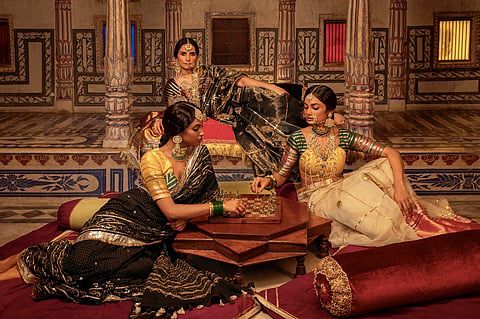
India’s legacy is often remembered through its forts, palaces and dynasties, but in a way some of its most compelling stories belong to the women who inhabited these spaces, whose influence shaped culture, aesthetics and everyday life from behind intricately carved walls. These quieter histories form the foundation of Rani Mahal, Sourav Das’s collection inspired by the women of Rajasthan’s royal households. The collection explores memory, craft and feminine authority while offering a deeper insight into the designer’s evolving creative language and enduring commitment to storytelling through textiles.
For Sourav, the collection began with an attempt to revisit a world that survives more in fragments than in documented history. “Spaces like Rani Mahal always exist in fragments within paintings, within memories, within the corners of palaces where stories were never written, only lived very intimately by the women of the janankhana,” he shares. “I was deeply inspired by the fresco colours of the carved walls in lesser-known palaces, not only because of their grandeur or royalty but because of the intimacy they hold.”
That distinction is central to understanding Rani Mahal. While royal India is often viewed through the lens of grandeur, Sourav’s fascination lies in the lives that unfolded behind it. He became interested in the women who inhabited these spaces and the details that shaped their worlds — the objects they cherished, the rituals they practised and the aesthetics that surrounded them. “The life of a janankhana had its own charm and excited me to visualise the lives of sensual women being part of such beautiful spaces,” he says. “That beauty was reflected in every aspect of their lives — be it the jewellery, the accessories, the handmade fans, the paan-daan, the chromium glasses, the hand-painted mural walls, the exquisite textiles, fineries, flowers and perfumes that adorned them.”
Sourav sought to capture this emotional essence. The collection imagines women who were both graceful and authoritative, whose identities were shaped as much by beauty as by intellect and influence. Through textiles, silhouettes and craft, Rani Mahal becomes an attempt to bring these women back into focus. The project acquired a deeper emotional resonance through Sourav’s collaboration with the Karansar family of Barli, Rajasthan. What initially began as a design exploration gradually evolved into an encounter with a remarkable family history — one that would become inseparable from the collection itself. “As part of the collaboration with the Karansar family, it had a deeper emotional connection with their Nani Sa’s memories,” he explains. “Interestingly, in a bygone patriarchal society, the fort was never owned by a man but passed down to the daughter of the family. I found it very fascinating to collaborate on such a project because it speaks about the authoritative status of a woman owning such a magnificent property in a historic era.”
The more time he spent within the estate, the more those histories revealed themselves. “The family also shared that it was the women of the family who had run the court along with other female dignitaries. Walking through the property, I noticed that most of the portraits hanging on the walls were of women. The power of their stories could still be felt,” Sourav adds.
The collection draws from the textile traditions and costumes of Rajasthan. Traditional cholis and bodices become the starting point for blouses, while handwoven Kota saris form the backbone of the collection. Yet every design decision is rooted in context and storytelling rather than aesthetics alone. Created as a spring-summer collection, the garments are built upon sheer kota doria woven with delicate zari threads, creating a tissue-like translucency that feels light yet luxurious. “I used a Kota weave because I wanted a very sheer translucent base,” he explains. “The collection was designed for summer, and because Kota comes from the land of Rajasthan itself, it felt naturally connected to the aesthetics and sensibility of the story.”
The collection’s colour palette emerged from the frescoes of Rajasthan’s lesser-known palaces. Rather than drawing from overtly regal references, Sourav looked towards surfaces weathered by time and memory. The result is a colour story that feels romantic and nuanced, carrying traces of the spaces that inspired it.
Looking at archival garments preserved within Rajasthan’s museums, forts and palaces, he became fascinated by the richness of their embellishment traditions and sought to reinterpret them through a contemporary lens. “I wanted to explore those very materials with a modern twist,” he says. “On a woven Kota base, I worked with gota embellishments, lampa work and zardozi because these techniques are deeply connected to Rajasthan’s visual culture. But I wanted to present them in a way that felt contemporary and true to my own aesthetic.”
In many ways, Rani Mahal also marks an important chapter in Sourav’s own evolution as a designer. “When I revisit my old collections and think about how it all started, I realise I was always a technically-oriented person,” he shares. “My focus was on quality and technicality. I concentrated on small nuances and detailing because I wanted the textile to have a museum-like quality.”
That foundation remains central to his work, but his creative ambitions have expanded over time. While craftsmanship continues to anchor his practice, he now finds himself increasingly drawn to richer and more layered forms of storytelling. “I always believed in extreme minimalism or extreme maximalism, but nowhere in between. When I started, I explored minimalism because that was what my resources allowed me to do. Today, I feel my platform gives me the freedom to explore the opulent, rich, bygone India — but in a very Sourav Das way.”
The shift is evident in Rani Mahal, which introduces hand embroidery as a significant component of his design vocabulary. Long recognised for his expertise in woven textiles, Sourav uses the collection to expand that conversation. “Most people have always perceived me as a weaving-oriented designer,” he says. “With this edit, I wanted to add another dimension to my textile journey by creating embroidered textiles. I wanted to explore the relationship between weave and embellishment and create something that felt fresh, while staying true to my practice.”
One of the most significant pieces within the collection is a black khadi resist-printed sari that Sourav considers especially close to his heart. Styled with jewel-toned accents and intricate embellishment, the piece encapsulates many of the ideas that define Rani Mahal. “Even though certain traditions sometimes associate red and black with negativity or mourning, I see them as colours of power and strength,” he adds.
The sari also reflects another recurring thread within his work: a conversation between Rajasthan and Hyderabad. While Rani Mahal is Rajasthani at its core, subtle references to Sourav’s own cultural upbringing appear throughout the pieces. Rich zardozi techniques, floral motifs and approaches to embellishment add a touch of Deccan.
If there is one idea that unites all of Sourav’s work, it is the belief that textiles cannot be separated from the cultural lives of the people who create and wear them. Fashion, for him, is a reflection of larger social, spiritual and cultural histories. “A good textile couldn’t have evolved if we didn’t dress our gods beautifully. Then we imagined fineries for our royalties because they were prestigious figures in society. Then we created the most magnificent saris for brides because it was their special day.Everything has a deeper meaning. Somewhere, everything sings together,” he explains.
This understanding was shaped through years spent working alongside artisan communities across India. His journeys through weaving clusters in Banaras, Chanderi, Maheshwar and Bengal allowed him to witness firsthand the knowledge systems that sustain Indian craft traditions. Those experiences continue to shape his work today. While many designers focus on well-documented craft traditions, Sourav often finds himself drawn to lesser-known regional histories and practices that risk fading from public consciousness. “I feel it is my responsibility to bring them back with contemporary relevance. That is how traditions survive — not by preserving them exactly as they were, but by allowing them to evolve and find meaning for a new generation.”
Perhaps that is why Sourav increasingly sees himself as a storyteller as much as a designer. Where textiles carry emotion and inspiration is found in stories forgotten.
Prices start at Rs 15,000. Available at Label Sourav Das, Crafts Council of Telangana, Banjara Hills and on request.
For more updates, join/follow our WhatsApp, Telegram and YouTube channels