
Sanjay Garg reflects on garlands, textiles and his London Fashion Week moment

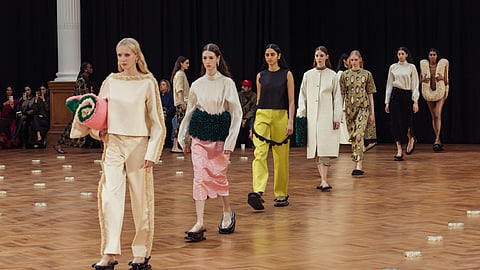
When Raw Mango made its London Fashion Week debut, the presentation was measured. There was no grand claim of arrival, no push for spectacle. Instead, the house unveiled its Fall/Winter 2026 collection, It’s Not About The Flower—a title that reads like both a refusal and an invitation.
Letting textiles speak louder than silhouettes
For nearly two decades, founder Sanjay Garg has built Raw Mango around a deep focus on textiles rather than passing trends. The show at London Fashion Week, presented by De Beers Group, featuring Forevermark Diamond Jewellery as the jewellery partner, marks a new geographic context but not a shift in philosophy. The collection focuses on the garland—an object so common to our visual culture that it often goes unnoticed. Across India, garlands are part of both major life events and everyday moments.They honour and consecrate, welcome and mourn—suspended across thresholds, placed on shrines, looped around portraits, exchanged in ceremonies. Their meaning comes not from a single flower, but from how they are arranged—the mix, the pattern and how closely they sit together.
It’s Not About The Flower considers this grammar. We speak to Sanjay Garg about presenting in London, the thinking behind the collection, and how the brand works within a system that constantly demands something new.
What does showing at London Fashion Week represent for Raw Mango at this point in its journey?
A stage is a stage. Presenting in London is as good as presenting in Kanpur, for me. At the end of the day, it is the work being presented that matters. And that doesn’t change according to who is viewing it, or where. I’m less interested in defining my audience and more interested in further exploring and articulating my design language that can cater to different audiences that transcends borders and seasons.
How do you hope an international audience will read Raw Mango—beyond the idea of “craft” or “heritage”?
Raw Mango has always spoken to the aesthetics and sensibilities of women who are conscious of quality, have a strong view on design and a confident sense of self. We are fortunate to have been able to have a dialogue and cultivate a relationship with a diverse set of clients who share these commonalities. That’s why our relationship with our audiences transcends across age groups, professions, interests and geographies. So wherever they come from, I think if we share similar worldviews, the audience will have no trouble reading Raw Mango.
The title suggests a refusal of the obvious. What is it not about—and what is it really about?
Too often, we limit our focus to the beauty that lives on the surface. Even in prints, heavy embroideries and large patterns—it’s the repetition of a single motif that creates the piece. Our new collection, It’s Not About The Flower, seeks to expand our focus to the garland instead of the single flower. We want each creation here to be appreciated in its entirety.
Every flower in a garland is unique, and at some point, each of them loses their individuality as they become part of something larger than themselves.
Look at how we interact with flowers in South Asian cultures. We don’t really have a culture of giving one individual flower to someone, like, say, a rose on Valentine’s Day. People do give but, as a culture, we are a country of garlands. Whether it’s a death, a birth, a wedding or a religious ritual, you see garlands, irrespective of the religion. So, I wanted to show through my collection how a 3D garland becomes the body rather than just a decoration. It’s not about one individual flower; it’s about the plurality.
Is this collection responding to a specific moment—political, cultural, or emotional—for you?
With each of my collections, I always want to share a broader perspective, not just aesthetically but in a way that reveals my personality as well as the brands. Over the last 18 years, we have been driven by a curiosity to understand the deliberate and spontaneous cultural movements that shape our values and systems as a society. The way we engage with culture is so varied that our work transcends across age groups, professions, interests, geographies.
That said, it’s hard to point to specific moments because every day brings new changes, challenges and insights. Even though the shifts in the culture are spontaneous, our work isn’t. Each collection still requires years of research, experimentation and development. So, in a way—yes, there are always commentaries and dialogue with the real world in our work, but what specifically are we responding to? We will leave it up to you to interpret. What speaks to you? What does it make you feel?
How does the idea behind this collection manifest in the textiles rather than the silhouettes?
This collection features very light embroidery. I wanted the garment’s underlying beauty to shine, which is often lost under the weight of excessive embroidery. The flowers and garlands we’ve used here were created and placed by hand. Jasmine-like shapes were assembled from laser-cut silk. Rajnigandhas (tuberoses) were hand-rolled from silk with a paper-like finish. We wanted to shift the focus away from the labour hours that go into making a garment to the immense creative and intellectual thought that flourishes in the subcontinent.
Do you think Indian textiles are still expected to perform a kind of “exoticism” on global runways? How do you resist that?
There is still a strong association between Indian fashion and a certain kind of aesthetic—heavy gold embroidery, and maximalist ensembles that overwhelm the eye and the body with “bling”. Indian fashion is too often quantified—it’s not seen for its innate aesthetic value, but the number of hours it took a weaver to create a garment. It’s a surface-level engagement that sometimes drowns out the beauty of the weave itself. In the long-term, it is the creative labour and overarching work that will matter, rather than what’s on the surface.
We are trying to reframe some of these narratives with It’s Not About The Flower. I want audiences to question how we can read a garment from the subcontinent through a focus on its creative rather than manual labour.
Raw Mango operates outside the usual seasonal churn. How do you engage with a fashion week system built on constant novelty?
Our work is a response to an internal pursuit—what excites us, what needs to be explored, what holds meaning. I am always designing something and thinking of ‘what next’ and given our design process, it takes years to materialise. Because our collection launches aren’t bound by seasons, what matters to us is the value we are adding to the industry, the craft and the conversation in general. We might not be present at every fashion week, but when we are, we always have something to say. That’s usually enough to set us apart.
—manuvipin@newindianexpress.com
@ManuVipin
For more updates, join/follow our WhatsApp, Telegram and YouTube channels.
https://whatsapp.com/channel/0029Vb677uz60eBXiDYheb0n