
- LIFESTYLE
- FASHION
- FOOD
- ENTERTAINMENT
- EVENTS
- CULTURE
- VIDEOS
- WEB STORIES
- SPORTS
- GADGETS
- CAR & BIKE
- TRAVEL
- SOCIETY
- GALLERIES
- NORTH EAST
- INDULGE CONNECT

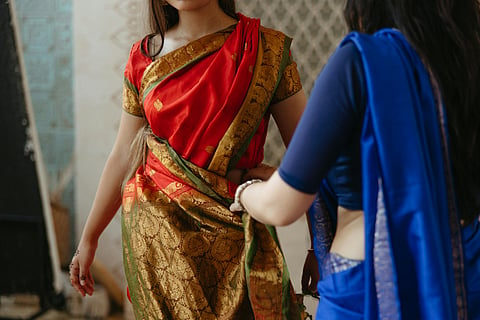
Have you ever cherished the experience of opening your cupboard, taking out your mother or grandmother’s handloom weaves and caressing the intricate zari patterns? Have you looked at these handloom weaves closely and noticed how the motifs shine and tell the story of the native place the garment comes from? The leaf-patterned jamdani from West Bengal, or the compact floral prints from Kashmir, the patiently made Gharchola from Gujarat or the nature –motifs of the Paithani borders from Maharashtra; all reflect the diversity of the sub-continent, yet bring everyone together as they share the joy of wearing a saree. This National Handloom Day, come journey with us around India through its weaves that are not only finding a place in Indian households as heirlooms but also making a mark on global platforms when worn by popular celebrities.
Today, handlooms are under renewed gaze and interest, with its weaves being adapted in apparels other than sarees into kurti, salwar kameez, t-shirts, home décor objects and even shoes. And now more than ever, it is the time to spotlight the traditional weaves to protect them from going extinct, plagiarised or unacknowledged by becoming vocal for local.
With so many weaves and traditions in place in the multi-cultural and diverse country, you might have to bring in your paper and pens to note them down. Starting from the north, Jammu Kashmir’s Pashmina weaves on fine wool have been adapted not only into sarees but also their very famous shawls.
Ladakh’s Goncha, mostly seen in the wrap around woollen coats and skirts worn by the locals, is hand-spun and hand-woven in villages like Saspol or Leh. Pattu is popularly worn by women in Himachal Pradesh, draped over their shoulders and tied securely in place. These are made from sheep wool and include bright geometric patterns and stripes with arrow, diamond or chevron motifs. Sometimes symbols from Buddhism are also drawn to make a Pattu.
Down South, each of the states have their own exquisite weaves which are famous world over. Karnataka’s Ilkal weaves have contrast borders, follow the tope teni method of joining the body and pallu works, and a bright and distinctive pallu. These sarees are usually worn by working women or folk performers, keeping in mind their comfort and durability.
If you like to opt for something simple yet elegant and eye-catching then Kerala’s Kasavu weave in plain white or off white sarees with golden borders would be just your thing. Specially preferred by brides in Tamil Nadu, the kanjeevaram woven on the finest silk with gold or silver thread with mythological, floral or geometric motifs, it is a saree which finds a place in every cupboard.
Drawing from the temple-state of Andhra Pradesh, the Dharmavaram includes temple motifs in gold and silver zari. These are popularly worn during festivities, weddings or temple rituals. Right from the Silk City of India comes the Pochampally weave. This ikat tie-and-dye inspired weave from Telangana is all about geometric designs. The Popai weaves native to the Andaman and Nicobar islands spotlights the natural environment of the place on their apparels.
Some of the finest weaves comes from Western and Central India. Step into Uttar Pradesh and the intricate Chikankari or the Banarasi sarees, which are a staple in every bride’s wardrobe in unavoidable. The light-on-skin, Chanderi Silk from Madhya Pradesh weaves in bright to pastel colours are apt for working women who prefer to look chic in their everyday sarees.
If vibrancy and colous dominate your wardrobe, then having a bandhni saree from Gujarat with its ombre shades are definitely head turning. Moreover, the Kota doria from Rajasthan complete with its wonderful embroideries on weaves is a must –have for your elegant wardrobe. Paithani, made by the local villagers of Maharashtra in remote areas have put the spotlight on the state due to its elaborate pallu designs drawn from nature motifs. Goa’s Kunbi draws from the tribal weaves of the Kunbi community and are easily recognisable through its red cotton thaans with white and black check patterns.
Turning your attention to East, the most promising and popular weaves are Jamdani and Baluchari from West Bengal followed by the lightly coars Tussar Silk from Jharkhand and Kosa Silk from Chattisgarh. In Odisha, the geometric patterns of Sambhalpuri weave and the thread weaves on cotton or silk, called Bomkai rank high in private collections of sarees. The elaborate Bhagalpur weaves from Bihar often depict instances from epics or mythology with intricate patterns woven into the fabric.
And lastly, but not the least comes the rising focus on North East India’s traditional patterns. While Assam’s Muga silk and Meghalaya’s eri silk weaving are GI certified, Tripura’s Pachra weave skirts with bright colours, geometric patterns and cotton-silk blend fabrics are no less behind. With stripes, zig zags and checks, Mizoram’s Puans are available in bright colours like red, blue, green and yellow. Manipur’s Moirang Phee is a cultural icon for all festive occasions. It is available in red, black and white colours with bold gold prints.
The Naga weave from Nagaland and Apatani weave from Arunachal Pradesh are special because each tribal community have their own motifs and patterns on which they make the weave. Overall, these patterns recall the bravery of the tribal wars, weapons, and nature through the weaves. The lepcha and the Bhutia communities of Sikkim adorn the Bakhu, their traditional dress in red, black, blue and white colours with symmetrical designs.
For more updates, join/follow our WhatsApp, Telegram and YouTube channels.