
- LIFESTYLE
- FASHION
- FOOD
- ENTERTAINMENT
- EVENTS
- CULTURE
- VIDEOS
- WEB STORIES
- SPORTS
- GADGETS
- CAR & BIKE
- TRAVEL
- SOCIETY
- GALLERIES
- NORTH EAST
- INDULGE CONNECT

Though India has several varieties of regional cheese, Kalari Cheese is one of the best-kept culinary secrets. Commonly referred to as ‘Mozzarella of the Himalayas’, this traditional cheese variety of Jammu & Kashmir is renowned for its elasticity and distinct serving method. This cheese variety has been a part of the Himalayan cuisine for generations now.
Kalari cheese is an aged pasta filata, which means stretched-curd cheese. This cheese is prepared from full-fat milk of cows, buffalo, or goats by Gujjars, the largest tribe in Jammu & Kashmir, and other agro-pastoral tribes of the region.
It starts by warming up fresh milk. After that, it is churned vigorously using a wooden spoon, and thereafter it is curdled using sour whey known as ‘matthar.’ The curd is separated from the whey and pressed manually into small round disks and allowed to dry under the sun for some days.
The milk used affects the colour and taste of the cheese. The cheese made from buffalo and goat’s milk is brighter white, while that from cow’s milk is lightly yellow. Fresh Kalari has a slightly milky flavour and a smooth, elastic texture like mozzarella cheese. As it matures, it gains a stronger and sharper flavour.
Regional variations do exist. Women from the regions of Udhampur and Reasi make softer Kalari with buffalo or goat milk. The Gujjars primarily use cow’s fresh milk to produce a yellowish Kalari cheese that looks like a flat chapati. This variant is commonly called doodh chapati or ‘milk bread.’
It is not known where exactly Kalari cheese originated. Some scholars say that the cheese-making practice came with the nomads from Central Asia and the Middle East. Others claim that it is native to the Jammu area.
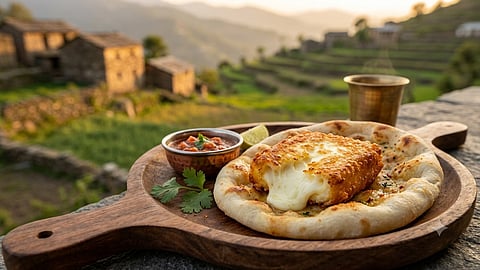
Currently, Kalari cheese is one of the most popular street foods in the entire Himalayan belt. This particular cheese item is always cooked to perfection by pan frying in either its natural fat, vegetable oil or animal fat until the exterior becomes crispy and golden, whereas the interior becomes gooey and melted. The dish can be seasoned with salt and is eaten in its original form or filled in kulchas and bread rolls.
For more updates, join/follow our WhatsApp, Telegram and YouTube channels.