
- LIFESTYLE
- FASHION
- FOOD
- ENTERTAINMENT
- EVENTS
- CULTURE
- VIDEOS
- WEB STORIES
- SPORTS
- GADGETS
- CAR & BIKE
- TRAVEL
- SOCIETY
- GALLERIES
- NORTH EAST
- INDULGE CONNECT
There was a time when going out to eat felt like an occasion in itself. Birthdays, anniversaries, promotions or good exam results marked those rare evenings when families dressed up, booked a table and celebrated. The excitement began long before the meal itself—choosing the restaurant, deciding what to wear, imagining the dishes to come. Eating out was an event, and part of its charm lay in the anticipation.
“There was a time when going to a restaurant meant deciding days in advance which place to choose for the outing, where everyone would chime in with their suggestions, and the thrill of choosing what to wear and what to eat was all part of the process,” recalls Himanshu Kohli, a resident of Saket in Delhi. “It was usually our parents’ anniversary or one of our birthdays. We knew that it was only five days in the year when we would go out to eat for sure. But now my siblings and I go out almost once or twice a week.”
From being rare and celebratory, restaurants have now become part of our everyday lives. They are spaces where people gather to unwind, where ideas take shape over coffee, and where the ordinary feels worth celebrating. Eating out today is less about occasion and more about experience.
But when the once-special becomes routine, how do chefs and restaurateurs keep things exciting? Enter the tasting menu.
A tasting menu is not just a meal; it is a journey told through food. Each course arrives like a chapter in a story, carrying its own emotion and memory. In an age when dining often feels hurried, a tasting menu invites you to slow down, to notice the details, to taste with intent. It is an experience built on trust—trust in the chef’s imagination and skill, in their ability to take you somewhere unexpected.
Last week, I went to Indian Accent for lunch with my husband and we chose to try the new tasting menu by chef Shantanu Mehrotra. Known for translating his creativity into dishes that surprise as much as they comfort, chef Mehrotra has been part of Indian Accent since its inception sixteen years ago and now leads it with quiet confidence.

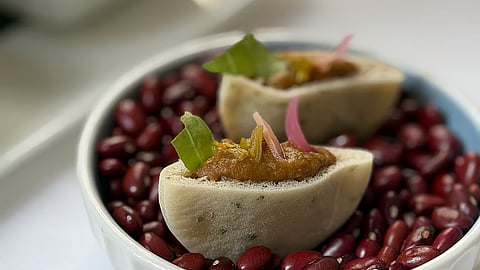
The menu began with dahi vada topped with Luxardo cherries, followed by a kachori served with a sweet and tangy Gujarati kadhi. There was even a playful take on Delhi’s favourite—chole bhature—reimagined as a bite-sized pita pocket. As an ode to the restaurant group’s Kashmiri roots, chef Mehrotra had created a lotus root dumpling in yakhni gravy, while the non-vegetarian version featured lamb dumplings with an aab gosht purée. Each dish was thoughtful, balanced and deeply rooted in memory.
When I asked him what makes a tasting menu special, he paused before saying, “At its heart, a tasting menu is an act of storytelling. The dishes speak of seasons and places, of memories and moods. A single course might evoke the scent of monsoon earth or the warmth of a family kitchen. Another might reimagine a traditional recipe through a modern technique.”
As a diner, Chittaranjan Park resident Snehlata Saikia shares a similar sentiment. “On special occasions or when I’m in a certain mood, I like to go for a chef’s tasting menu for their interpretation of Indian cuisine paired with European influences,” she says. “For example, at Indian Accent, the chef uses blue cheese in Indian dishes. I also enjoy when a chef focuses on artistic presentation along with robust flavours. If I’m spending a good amount, I want both—a beautiful presentation and the experience of a tasting menu.”
Each course in a tasting menu reveals not just a new flavour but a new idea. It becomes a meditation on balance and restraint, a choreography of temperature, colour and form. Even the quiet moments between courses—the anticipation before the next plate arrives—become part of its theatre.
Ultimately, a tasting menu is an invitation to slow down, to be surprised, and to rediscover the joy of dining. It transforms food into conversation and flavour into memory—a reminder that even in our fast-paced world, the most meaningful experiences are those that ask us to pause and savour.