
- LIFESTYLE
- FASHION
- FOOD
- ENTERTAINMENT
- EVENTS
- CULTURE
- VIDEOS
- WEB STORIES
- SPORTS
- GADGETS
- CAR & BIKE
- TRAVEL
- SOCIETY
- GALLERIES
- NORTH EAST
- INDULGE CONNECT

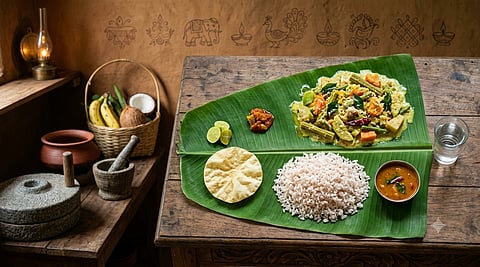
For many generations, Avial has not been merely a conventional dish from Kerala. The history of this dish goes back to the time of the Mahabharata, when, according to legend, Bhima prepared the dish while living the life of an incognito person. Comprising different vegetables along with coconut, curd, and coconut oil, it is also considered the earliest example of zero-waste cooking.
This story takes us back to the time when the Pandavas lived in disguise in the kingdom of Virata, during the last year of their exile. After losing to the Kauravas in the game of dice, the brothers were forced into living in exile. During this time, Bhima took up the name of Vallabha (Ballava) and became a cook in the royal palace of King Virata.
As per the folklore, Bhima was not a good cook. Once, while making curry, he could not get enough items for preparation. He gathered all the vegetables he found in the kitchen, cut them, and boiled them in an iron pot along with grated coconut. The king enjoyed this dish very much, and thus it became popular under the name of Avial.
Another rendition of this tale revolves around the fact that the dish was cooked during a sudden feast arranged by King Virata. Due to sudden guests, there were not enough vegetables to make individual dishes. Bhima came up with a clever idea and made a single dish out of all the available vegetables.
There is also a story related to Bhima’s childhood about the origin of the dish. Once, the Kauravas tried to kill him by poisoning and throwing him into the water, and proclaimed that he had died. After Bhima was saved from the Nagas, he saw the vegetables ready for the funeral feast and made them into one dish.
As time passed, Avial migrated through various areas, creating new mixed vegetable preparations. Some similar dishes like Bengali Shukto and Gujarati Undhiyu were prepared in their own style. The traditional dish retained its uniqueness by adding yoghurt, coconut, curry leaves, and coconut oil.
For more updates, join/follow our WhatsApp, Telegram and YouTube channels.