
- LIFESTYLE
- FASHION
- FOOD
- ENTERTAINMENT
- EVENTS
- CULTURE
- VIDEOS
- WEB STORIES
- SPORTS
- GADGETS
- CAR & BIKE
- TRAVEL
- SOCIETY
- GALLERIES
- NORTH EAST
- INDULGE CONNECT

From fighting for your pockets to your wrists and ears, the battle for tech claiming bodily real estate has landed on the most prized of fronts: your face. What was once a niche, somewhat-reviled corner of tech (remember Google Glass from over ten years ago?) is now one of its most exciting frontiers, and new devices are launching at a blistering pace, packed with AI-powered cameras, displays, and sensors built into their frames. Let’s face it, you’re likely to be rocking one in the year to come, so here’s pick of the latest smart glasses, stuff to (quite literally) watch out for!
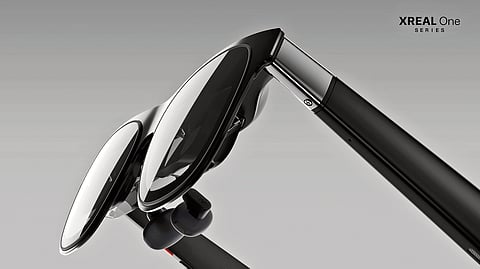
For those looking for a premium pair of augmented reality glasses with a price tag to match, it doesn’t get better than the Xreal One Pro. For the price, you get Xreal’s new flat prism design which shrinks the display hardware while expanding the experience, giving you a simulated 171-inch display with a wide 57-degree field of view, 1080p resolution and up to 120-Hz refresh rate, all just inches away from your eyes for that all-enveloping virtual theater experience. Thanks to Xreal’s X1 chip built in, you get 3 degrees of freedom (3-DoF), so you can pin a screen into a point in space - the back of a plane seat, for example - hit the electrochromic film to dim the lenses, and game or work in complete immersion. Built-in Bose stereo speakers are a bonus. When you want more, you can pop out the nose pad and slot in the Eye camera ($99) for 6 DoF tracking in all directions, no matter how you walk, lean, or shift your view.
I’ve been rocking the first-generation Ray-Ban Meta glasses for over a year now, and they’ve gone from being a stylish pair of shades with a surprisingly great camera and speakers to a Meta AI-boosted pair of smart shades that can identify objects simply by looking at them, answer queries in your ear and much more, arguably the best and most accessible multi-modal AI hardware you can buy. Gen 2 retains much of the same style and smarts, adding in a higher resolution 3K video capture (from 1080p) and takes the battery life up to 6 hours on the prior model to 8 hours. The best bit about these smart glasses still remains the same – they are a solid piece of AI-first hardware that comes across as a fashion accessory, so they can be worn for hours on end and still function like a pair of Ray-Bans long after the battery runs out!
Meta Ray-Ban Display
From a page right out of future arrive the Meta Ray-Ban Display smart glasses, and boy, are they an upgrade over even the Gen 2! Sure, they are AI-powered, and even have a 600 x 600 pixels in-lens display that shows up AI search results, maps navigation, voice transcription, and it even acts as a viewfinder for the 12MP camera or while livestreaming. What’s capturing our collective interest is how you control the Display - with the Neural Band, a small wrist strap that uses an electromyography (EMG) sensor to read the subtle signals from the muscles in your wrist, so that you can control the display with hand gestures. For instance, you can slide your thumb along the top of your index finger to move left and right, up and down to move vertically, and tap to activate controls…and the coolest bit – pinch and rotate your fingers to control an imaginary volume knob!
Rayneo Air 3s Pro
If you’re dipping your feet in the smart glass pool, the TCL-owned RayNeo Air 3s Pro will let you do so without breaking the bank. For less than any of its peers, you get seriously strong AR glasses that plug into any USB-C compatible device – a virtual 201-inch theater screen (from 20 feet away) with a 46-degree field of view, and sharp 1080p visuals with bright and incredibly vibrant colors. Built-in audio is pleasantly bassy, and the frames have an excellent weight distribution, but there are tradeoffs for the price – no fancy spatial computing or 3DoF head-tracking features - so these are less of a look into the future and more a pair of glasses you can buy right now, and for the price, they nail the brief.
For more updates, join/follow our WhatsApp, Telegram and YouTube channels.