
- LIFESTYLE
- FASHION
- FOOD
- ENTERTAINMENT
- EVENTS
- CULTURE
- VIDEOS
- WEB STORIES
- SPORTS
- GADGETS
- CAR & BIKE
- TRAVEL
- SOCIETY
- GALLERIES
- NORTH EAST
- INDULGE CONNECT

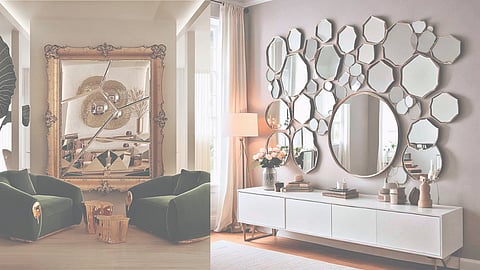
There was a time when a dramatic chandelier was the undisputed centrepiece of a room. Today, however, the spotlight has shifted to the walls. Mirrors are no longer simply reflective surfaces tucked into entryways or powder rooms. They have evolved into sculptural objects that command attention, blur the boundaries between art and function, and often become the defining feature of a space.
The rise of handcrafted statement mirrors in contemporary interiors
Oversized, handcrafted and rich in texture, statement mirrors are reshaping contemporary interiors. Whether framed in carved wood, cast in metal, moulded in organic forms or infused with artistic imagery, they do far more than brighten a room. They introduce personality, create depth and serve as conversation starters.
Designers agree that the role of the mirror has undergone a remarkable transformation. "I think we stopped decorating rooms and started composing them," says Bani Kohli Jain, founder of Saar. "A mirror is the only object in a house that changes every time you walk past it, which makes it the closest thing architecture has to a living surface."
For Bani, the shift reflects a broader change in how homeowners approach interiors. "For decades a mirror was there to do a quiet job—make the hallway less mean, check your collar on the way out. Now we want it to announce itself. We want it to be the thing you notice before you notice yourself. That is not vanity, that is confidence."
That sentiment is echoed by Abhaye Gupta, founder of Rabyana Design, who believes mirrors should captivate before they even begin reflecting a room. "Every design begins as a sculptural concept where proportion, form and materiality are considered as carefully as functionality," he says. "We approach each mirror as a piece of wall art that adds depth, character and emotion to a space." Instead of blending into the background, today's mirrors are designed to anchor a room, much like a sculpture or a striking painting.
The move away from minimal, invisible mirrors has also fuelled a renewed appreciation for craftsmanship. "Handcrafted detailing, sculptural frames, organic and fluid forms, as well as oversized designs create visual impact," says Abhaye. "The trend is moving away from purely minimal designs towards pieces that celebrate craftsmanship, individuality and enduring quality."
At HōmAnAn, founder Anubha Aneja sees mirrors as storytellers rather than accessories. "A thoughtfully chosen statement mirror becomes a sculptural element, introducing texture, craftsmanship and personality while visually expanding a space," she says. "Mirrors aren't just for looking into—they're designed to be looked at." Her curation ranges from tactile FRP and mixed-material compositions to carved teakwood and timeless ashwood frames, each selected to become a focal point rather than simply fill an empty wall.
Perhaps nowhere is this evolution more evident than in collectible design. Luxury interiors platform STRROT recently introduced the TOILETPAPER Lipsticks Mirror by Italian design house Seletti to India. With its pear-shaped silhouette, gilded frame and surreal image of multiple hands applying bright red lipstick, the mirror blurs the boundaries between furniture, photography and contemporary art.
Designed by the creative minds behind the cult publication TOILETPAPER, it transforms an everyday object into a statement piece that brings wit, glamour and personality into a room—whether placed in a foyer, dressing area or living room.
The growing popularity of such collectible objects reflects a wider shift towards homes that feel deeply personal rather than perfectly matched.
The appeal of statement mirrors isn't purely aesthetic. In compact urban homes, they have become one of the smartest design tools for manipulating light and perception. "Mirrors have evolved beyond their traditional function to become integral design elements that shape the character of a space," says Swetha Vegesana, founder of Intent Made.
Positioned thoughtfully, they can reflect natural light, frame an architectural detail or visually extend a room without altering its footprint. "There is a growing appreciation for craftsmanship and materials," she says. "Rather than blending into the background, mirrors are now designed to contribute to the architecture of a room through their form, texture and finish."
Swetha also cautions against an approach that was once commonplace: covering entire walls in mirror panels. "Instead of overusing mirrored surfaces, we're seeing a move towards statement mirrors that combine artistry with function. They create depth and light while also acting as focal points."
A statement mirror can elevate a room—but only when it is placed thoughtfully. Treat it as a finish, not a fixture," advises Bani. "A mirror on a wall opposite something worth reflecting is design."
Instead of positioning a mirror directly opposite a window, she recommends placing it at right angles to the light source. "You get glow rather than glare," she explains. Another overlooked trick? Hang it low enough to reflect the floor. "That gives you depth," says Bani. "Hang it high and all you have bought yourself is a second ceiling."
Abhaye also stresses the importance of proportion. A mirror should relate to the furniture and architecture around it rather than simply filling an empty wall. Whenever possible, he recommends placing it where it can capture natural light or reflect a beautiful view.
Looking ahead, softer forms are replacing rigid geometry. Bani predicts arches, ovals, softly irregular silhouettes and oversized leaning mirrors will continue to dominate interiors, while aged brass and high-gloss lacquered finishes are emerging as favourites.
"The frame is the whole decision," she says. "It decides whether the mirror reads as furniture or as an afterthought." That attention to craftsmanship and thoughtful design signals a broader change in how we decorate our homes. Mirrors are no longer chosen at the end of a project to fill a blank wall. They are selected early, much like furniture or art, because they influence how a room feels, functions and tells its story.
—manuvipin@newindianexpress.com
For more updates, join/follow our
https://www.whatsapp.com/channel/0029Vb677uz60eBXiDYheb0n