
- LIFESTYLE
- FASHION
- FOOD
- ENTERTAINMENT
- EVENTS
- CULTURE
- VIDEOS
- WEB STORIES
- SPORTS
- GADGETS
- CAR & BIKE
- TRAVEL
- SOCIETY
- GALLERIES
- NORTH EAST
- INDULGE CONNECT

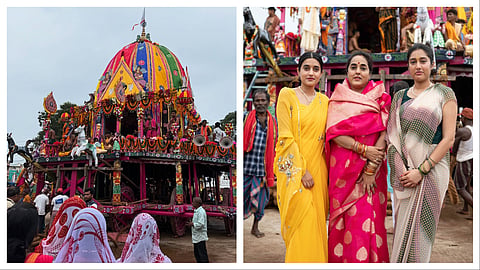
Every year, as millions turn their eyes to Puri for Odisha's grand Rath Yatra, another centuries-old procession quietly unfolds the following day in Baripada. Smaller in scale but no less steeped in devotion, the town's 450-year-old Rath Yatra is often called Dwitiya Srikshetra, the Second Abode of Lord Jagannath. Yet what makes it truly remarkable is not just its age or royal legacy, but a tradition found nowhere else in the world: the chariot of Goddess Subhadra is pulled exclusively by women.
The origins of this festival lie in a moment of exclusion that transformed into an enduring act of faith.
According to historical accounts, the roots of Baripada's Rath Yatra stretch back to 1575, when Maharaja Baidyanath Bhanj established the Haribaldev Jew Temple. The decision came after members of the royal household and army from the erstwhile Mayurbhanj kingdom were reportedly denied entry into the Jagannath Temple in Puri.
In response, the king established the Haribaldev Jew Temple at Baripada so the people of Mayurbhanj could worship Lord Jagannath closer to home.
"Baripada’s Rath Yatra has run without interruption for 450 years," says Maharajkumari Akshita Manjari Bhanj Deo, who along with her sister Maharajkumari Mrinalika Manjari Bhanj Deo are the 48th generation of the Bhanj Dynasty, which traces its lineage to 697AD and has ruled in unbroken succession for 1200 years
"Founded in 1575 by Maharaja Baidyanath Bhanj who built the Haribaldev Jew temple as a deliberate echo of Puri’s Jagannath temple when he was denied entry at Puri, it is known as Dwitiya Srikshetra, the Second Abode of Lord Jagannath and is celebrated the day after Puri’s festival every year," Akshita adds.
A festival born from a royal rebuff
The Haribaldev Jew Temple was conceived as a deliberate reflection of Puri's revered shrine, ensuring that the people of Mayurbhanj could celebrate the deity without undertaking the long pilgrimage to the coast. Over time, Baripada earned the title of Dwitiya Srikshetra, a recognition of its deep spiritual association with Lord Jagannath and its enduring Rath Yatra traditions.
Today, Baripada's Rath Yatra is regarded as the second most auspicious celebration of the festival after Puri, drawing thousands of devotees every year. Significantly, it is always observed a day after the Puri Rath Yatra, preserving a rhythm that has continued uninterrupted for nearly four and a half centuries.
The chariot that only women draw
The festival's most distinctive feature, however, belongs to Goddess Subhadra.
While devotees of every background pull the chariots in most Rath Yatras across India, Baripada follows a custom that has become synonymous with its identity. For the past five decades, the chariot carrying Goddess Subhadra has been pulled exclusively by women. The sight of hundreds of women gripping the thick ceremonial ropes and guiding the deity through Baripada's streets has become one of Odisha's most powerful expressions of collective devotion.
The tradition is both symbolic and deeply participatory. It offers women a central ritual role in one of Hinduism's most celebrated festivals, an honour rarely seen in such a prominent public procession. What began decades ago has since become an integral part of Baripada's cultural identity, eagerly anticipated by generations of women who regard it as both privilege and prayer.
A 1975 initiative became an enduring ritual
The tradition of women exclusively pulling the Devadalana, Goddess Subhadra's chariot, is a relatively recent addition to Baripada's centuries-old Rath Yatra. It dates back to 1975, when the world observed the first International Women's Year.
Inspired by the occasion, then Mayurbhanj District Collector Vivekananda Patnaik introduced the initiative to encourage greater participation by women in the festival. The move also addressed safety concerns following an incident in the 1950s in which a woman was injured while helping pull a chariot. What began as a progressive measure soon struck a chord with devotees and evolved into one of Baripada Rath Yatra's most distinctive and cherished traditions.
For more updates, join/follow our WhatsApp, Telegram and YouTube channels.