
- LIFESTYLE
- FASHION
- FOOD
- ENTERTAINMENT
- EVENTS
- CULTURE
- VIDEOS
- WEB STORIES
- SPORTS
- GADGETS
- CAR & BIKE
- TRAVEL
- SOCIETY
- GALLERIES
- NORTH EAST
- INDULGE CONNECT
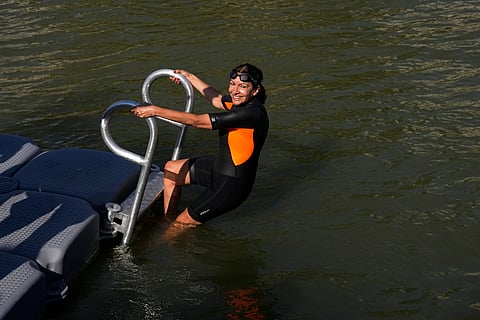
Following in the footsteps of French Sports Minister Amélie Oudéa-Castéra, who swam in the Seine on Saturday (July 13), Anne Hidalgo, Paris 2024 chief Tony Estanguet, and the top government official for the Paris region, Marc Guillaume, joined her on Wednesday, along with swimmers from local swimming clubs.

Daily water quality tests in early June had indicated unsafe levels of E. coli bacteria. Clad in a wetsuit and goggles, Hidalgo plunged into the river near the imposing-looking City Hall, her office, and the Notre Dame Cathedral.
“The Seine is exquisite,” said Hidalgo from the water. After emerging, she continued to rave, “The water is very, very good. A little cool, but not so bad.'' She also said today was “a dream” and a “testimony that we have achieved a lot of work,” referencing the city’s “swimming plan” that was launched in 2015.
“After twenty years of doing sports in the river, I find it admirable that we are trying to clean it up,” said Estanguet, who has three Olympic gold medals in canoeing. They swam down the river for about 100 meters, switching between crawl and breaststroke.
It’s part of a broader effort to showcase the river’s improved cleanliness ahead of the Summer Games which will kick off July 26 with a lavish open-air ceremony that includes an athletes’ parade on boats on the Seine.
Swimming in the Seine has been banned for over a century. Since 2015, organizers have invested $1.5 billion to prepare the Seine for the Olympics and to ensure Parisians have a cleaner river after the Games. The plan included constructing a giant underground water storage basin in central Paris, renovating sewer infrastructure, and upgrading wastewater treatment plants.
Originally planned for June, Hidalgo’s swim was postponed due to snap parliamentary elections in France. On the initial date, the hashtag ”jechiedanslaSeine” (“I’m pooping in the Seine”) trended on social media as some threatened to protest the Olympics by defecating upstream.
That didn't deter Hidalgo, who carefully entered the river Wednesday using a ladder on an artificial pond, set up for the event. Seven security boats were deployed for the occasion.
Enzo Gallet, a competitive swimmer who has taken part in France's national open-water championship, was among athletes invited to test the Seine alongside the Paris mayor.
The 23-year-old swam just a few meters from Hidalgo. “Her crawl form was pretty good,” he said, emerging from the water. “It’s pretty special to be among those who swam in the middle of Paris for the first time in a long, long time.”
After the officials had left the Seine river banks, many swimmers were still in the water, some playing catch with a ball and others practicing their dives from the artificial pond — all in a very festive mood.
Other politicians have promised to clean up the Seine. Jacques Chirac, the former French president, made a similar pledge in 1988 when he was Paris mayor, but it was never realized.
The founder of the modern Olympics and former IOC president, Pierre de Coubertin, once said women competing in the Games would be “impractical, uninteresting, unaesthetic and improper.”
Over a century later, the 2024 Paris Olympic Games are targeting gender parity in the same city where women made their Olympic debut in 1900.
The IOC set a goal of a 50-50 split among the more than 11,000 men and women, including backups, registered to compete from July 26 to Aug. 11. However, the latest numbers from the IOC suggest organizers might fall just short of that target.
There is still a slight edge toward men among the 329 medal events at the Paris Olympics. The IOC has said there are 157 men's events, 152 women’s events and 20 mixed-gender events.
Of the 32 sports, 28 are “ fully gender equal,” the IOC said, including the new event of breaking to music. Rhythmic gymnastics is still for women only but men are allowed to compete in artistic swimming.
Mixed-gender team events were strongly pushed. In Tokyo three years ago, vivid images were created by debuts for 4x400 meters mixed relay on the track and 4x100 mixed medley relay in swimming.
“There is nothing more equal than a male and female competing as one team on the same field of play towards the same sports performance,” the IOC’s sports director, Kit McConnell, has said.
One week before the opening ceremony, the official IOC database for the Paris Olympics showed 11,215 athletes, including backups, registered to compete: 5,712 in men's events and 5,503 in women's events or a 51-49% split.
In track and field, which has qualifying standards the athletes much reach, there were 50 more registered for the men's events than women's: 1,091-1,041. In swimming, the difference was 464-393.
In soccer, with 16 teams in the men’s tournament and just 12 in the women’s, the athlete tally was 351-264. The wrestling entry has 193 men and 96 women, with a men-only category in Greco-Roman.
In equestrian, where men and women compete in the same events, entries were 154-96.
No men were registered in artistic swimming or rhythmic gymnastics, which have a total of 200 women. There's no men's category in rhythmic gymnastics.
As the biggest team at the Paris Olympics, the United States has the most competitors in women's events with 338, or 53% of its 638-strong delegation, according to the IOC’s games database this week.
The 38 fewer men is partly because the U.S. qualified a squad of 19 in women’s field hockey but didn’t qualify in the men’s competition, and registered nine women in artistic swimming.
France, with invitations to compete in every team event, had 293 female athletes registered. Australia had 276, China 259 and Germany 239.
Other teams, albeit with many fewer athletes, have more women on their squads.
Guam, a U.S. island territory east of the Philippines, led the way with 87.5% women — seven in its team of eight athletes, according to the IOC database. Guam’s seven women are in six different sports. Nicaragua is set to arrive with 86% women — six of its seven athletes — and Sierra Leone with 80%.
Kosovo’s strength in women’s judo — four of its total team of nine athletes — lifts its percentage of women to 77%. North Korea, Laos and Vietnam each has 75% female athletes on their teams.
Six of the 205 official Olympic teams had no elite-level female athlete registered to compete: Belize, Guinea-Bissau, Iraq, Liechtenstein, Nauru and Somalia.
Qatar, which wants to host the 2036 Olympics, has just one woman in its 14-athlete team or 7%. Half the Qatari team represents men’s track and field, including the defending champion in high jump Mutaz Essa Barshim.
Mali and South Sudan are at 7%. Mali will send 22 male soccer players and South Sudan 12 athletes in men’s basketball.
El Salvador has one woman among eight athletes (12.5%).
The registered entries to women’s events in Paris include two athletes who identify as nonbinary and transgender.
Nikki Hiltz won the 1,500 meters event at the U.S. track and field trials last month and will make their Olympic debut at Stade de France.
Quinn won Olympic gold with the Canadian soccer team in Tokyo three years ago and returns to help defend the title.
Paris hosted the first female athletes at the 1900 Olympics — in the second modern Games — with 22 of the 997 athletes in competition, or 2.2% of the total. The modern Olympics began in 1896 in Athens.
Women competed in tennis and golf, plus team events of sailing, croquet and equestrian in Paris.
Charlotte Cooper of Britain was the first female individual gold medalist in tennis singles.
Just 4.4% of the athletes were women when Paris again hosted the Olympics exactly 100 years ago. In 1924, the “Chariots of Fire” Olympics, there were 135 women competing among 3,089 athletes, according to the IOC’s research.
The number rose to 9.5% at the 1932 Los Angeles Olympics, dropped to 8.4% in Berlin four years later, and got back to 9.5% when the Summer Games were held in London in 1948.
The rise included a bump to 20.7% female athletes in Montreal in 1976 and got close to 23% when the Games returned to Los Angeles in 1984. That's when rhythmic gymnastics and artistic swimming, then called synchronized, made their debuts.
The IOC put pressure on Olympic teams that traditionally sent only men to complete. Saudi Arabia, Qatar and Brunei included women for the first time at the 2012 London Olympics. That's where 44.2% of the athletes competed in women’s events at the Olympics. The number rose to 45% in Rio 2016 and reached 48% at the Tokyo Games, where teams were encouraged to select a man and a woman to be flag-bearers at the opening ceremony.
The IOC formally committed to “foster gender quality” as part of a package of wide-ranging reforms pushed in December 2014 by the recently-elected president Thomas Bach.
The IOC’s sports department worked with the sports' governing bodies to remove some men’s medal events and add more for women. The federations have since achieved more equity on the field of play for female athletes than for women in their own offices.
A 2020 review of the 31 sports governing bodies at the Tokyo Olympics found only one achieved 40% women on its board and 18 had female representation of 25% or less.