
- LIFESTYLE
- FASHION
- FOOD
- ENTERTAINMENT
- EVENTS
- CULTURE
- VIDEOS
- WEB STORIES
- GALLERIES
- GADGETS
- CAR & BIKE
- SOCIETY
- TRAVEL
- NORTH EAST
- INDULGE CONNECT
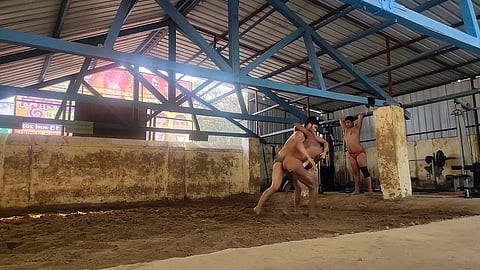
At 4:30 pm, the Guru Hanuman Akhara, Model Town, stirs. The akhara becomes a hive of activity as wrestlers do push-ups, lift weights, climb ropes and rehearse stance drills as they prepare for the evening. Wrestlers aged 10 to 25 take out shovels to scrape the soil. The traditional mud pit, where the fight takes place, is dug and levelled.
Veteran guru Charan Das, the main trainer, takes position as referee. Two wrestlers step into the pit, circling for grip and balance, then lunge forward, trying to force the other’s shoulders into the mud. “It’s not just a match,” says 22-year-old Raj Guru Singh, who has trained here for three years. “It’s everything you’ve built through months of practice, discipline and trust in your training, tested in real time.” Singh currently trains full-time at the akhara while preparing for state and national-level selection tournaments.
Rooted in the guru-shishya parampara, traditional mud-pit dangals are, however, slowly losing ground to Olympic freestyle wrestling. While dangals continue to offer local prize money from a few thousand rupees in junior bouts to over ₹1 lakh in senior dangals, mat competitions increasingly determine access to government jobs, funding and international pathways.
Amidst these changes, akharas like Guru Hanuman established in 1925, stand as living archives of a culture adapting to survive. Many akharas now supplement mud training with mat practice, send wrestlers regularly to federation tournaments, and encourage participation in national selection trials so that trainees can access institutional support and government employment opportunities.
Routine and formats
For senior trainer Guru Charan Das, associated with the akhara since 1968, wrestling is “knowledge shaped through years of practice”. A veteran wrestler who represented India at the 1974 Asian Games, he has been training wrestlers at the akhara since the 1990s. Over 100 trainees from Haryana, UP, Bihar, Punjab, Delhi, and Himachal Pradesh, gather daily, many residing on-site. “We wake at 4 am, practice four to five hours in the morning, and again in the evening,” Das notes. “The soil comes from farms, prepared by hand.” He recalls winning at the School National Games in Cuttack and the National Games in Bombay in the early 1970s, when the akhara produced most national medallists.
Continuity of tradition is maintained by senior wrestlers. They are the current mentors, ensuring the sport remains “a guide toward discipline and letting the traditions of akhara survive”.
The sport has two formats. Dangals – traditional kushtis fought on mud – are hosted by local committees with no age or weight limits; a game usually lasts between 15 and 30 minutes. Victory requires pinning the opponent’s back to the mud. Junior bouts offer prize money ranging from ₹500 and ₹1,100 to ₹5,100–₹11,000, while senior matches can fetch up to ₹1- 1.5 lakh.
Mat wrestling uses points: back exposure earns 2 points, a lift-technique back expose earns 4, and a push from the circle earns 1. Matches run for 7 minutes with 30-second breaks. Yet concerns remain. “Steroids are common, especially in dangals,” Singh says. “There are no stringent measures to curb usage.”

The mat advantage
“The mat has become commonplace and is the future," says Singh. Success on the mat can help secure government jobs. “My father was a wrestler and is now a police officer in Jharkhand. If you adapt to mat wrestling, you can compete in both formats. But if you only train in dangal, it becomes difficult to transition. The traditional format is slowly becoming generational.
Similar sentiments are echoed by 2021 Tokyo Olympic silver medallist Ravi Kumar Dahiya, now an assistant director with the Delhi government posted at Chhatrasal Stadium. He pushes for modernisation. “Traditional mud is culture, but the Olympic mat is important,” he says. “Government funding flows when you represent your state or country. If we train only in mud without facilities, what happens next? We must move forward.” Dahiya emphasises mental rigour. “Avoid distractions. I stayed off phones for a year and a half during training. Visualise your bouts.”
Dahiya says he is optimistic about the girls’ progress. “Girls today show tremendous grit and passion, especially in Haryana, and with growing family support and better opportunities, more are stepping onto the mat,” he says. “With the right encouragement, they can go a long way.”
For Singh and his fellow wrestlers, the immediate focus is the upcoming U-20 and U-23 national tournaments, where success can open doors to government jobs, while medals can fetch good money through state bonuses and sponsorships. As dusk settles at Guru Hanuman, the soil is packed, the milk poured, and the circle waits. Indian wrestling may be caught between heritage and progression, but in the dust of this Delhi akhara, it continues to teach what it always has: how to fall, how to fight, and how to rise.
This article is written by S Keerthivas