
- LIFESTYLE
- FASHION
- FOOD
- ENTERTAINMENT
- EVENTS
- CULTURE
- VIDEOS
- WEB STORIES
- SPORTS
- GADGETS
- CAR & BIKE
- TRAVEL
- SOCIETY
- GALLERIES
- NORTH EAST
- INDULGE CONNECT

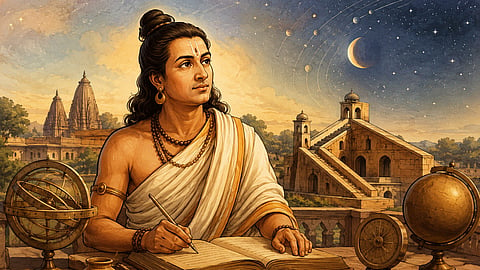
The scientific community of ancient India has produced many outstanding scholars, but one of the most well-regarded names in that community is Varahamihira. Born near Ujjain, dating back to 505-587 CE, he was an astronomer, mathematician, astrologer, and philosopher whose work would influence scholars for generations to come.
According to reports, Varahamihira came from a Brahmin family and was born at Kapittha near Ujjain. His father, Adityadasa, was a follower of Surya, the Sun God and taught him about astronomy and astrology. It is also believed that he undertook rigorous penance and gained divine grace, which made him a master in mathematics, astrology and astronomical science.
It is believed that he was one of the famous Navratnas, or Nine Gems, at the court of King Vikramaditya. He earned great fame for his accurate predictions. The most famous legend associated with this sage is that of a royal prince. Based on the prince's horoscope, he predicted that the boy was going to die at the age of 18 due to the attack of a boar.
The king took precautions by securing the prince from animals. But when the day of the forecasted calamity came, a metal statue of a boar, which was the royal emblem mounted on top of the palace, was said to have broken off due to strong winds and fallen on the prince, killing him.
The most important contribution made by Varahamihira is the Panchasiddhantika. It consisted of five previously existing traditions of astronomy; namely, Surya Siddhanta, Paulisha Siddhanta, Romaka Siddhanta, Vasishta Siddhanta and Paitamaha Siddhanta. This work contains a lot of important information on astronomy. This book deals with the movement of planets, stars and the occurrence of eclipses.
His writings also covered the calculated diameter of Mercury, Venus, Mars, Jupiter, and Saturn. He made contributions to trigonometry through improving sine tables created by Aryabhata. He also described mathematical theories related to zero, positive numbers, and negative numbers.
He also used a technique close to Pascal's Triangle for calculating binomial coefficients. Varahamihira wrote several books, among which is the Brihat Samhita. It is an Encyclopedia dealing with architecture, agriculture, meteorology, hydrology, and geology.
He was also the first to notice that plants and termite activity indicated the presence of underground water. A few of the later interpretations have also claimed that Varahamihira described the presence of water and iron on Mars in his treatise called Panchasiddhantika and linked it to modern discoveries made by NASA and ISRO.
For more updates, join/follow our WhatsApp, Telegram and YouTube channels.