
- LIFESTYLE
- FASHION
- FOOD
- ENTERTAINMENT
- EVENTS
- CULTURE
- VIDEOS
- WEB STORIES
- SPORTS
- GADGETS
- CAR & BIKE
- TRAVEL
- SOCIETY
- GALLERIES
- NORTH EAST
- INDULGE CONNECT

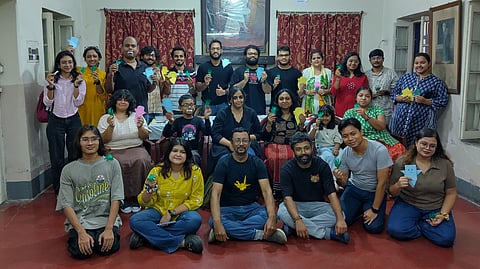
A fold here, a crease there, a tuck here and a lock there — that’s how easy the art of paper folding can be. Known as origami, this Japanese art form derives its name from the Japanese words– oru (fold) and kami (paper). Any child who grew up in the ’80s and ’90s would fondly remember floating paper boats along the rain-soaked streets of Kolkata during the monsoon. Many school children would also have mischievously aimed paper planes at their teachers whenever they turned around to write on the blackboard. Did you ever imagine that the simple act of folding paper to create boats or planes is, in fact, part of a vast and intricate art form? In Kolkata, there is a steadily growing origami community, comprising members of all ages and professions who voluntarily attend monthly meet-ups to practise, exchange knowledge, and benefit from the practice.
All about the Kolkata Origani Centre
While there is no documented evidence of when origami was introduced to India and Kolkata, one can say that Indo-Japanese exchanges around the 1950s and ’70s were a major boost in bringing this art to India. Since then, origami has been practised through workshops and institutional craft classes. However, a compact organisation that brought together all like-minded veteran and emerging origamists was formed in 2012.
Chiroranjan Bose, coordinator of the centre, recalls, “It was inaugurated in November 2012 when Sensei Kazuko Kobayashi, the present Chairman of the International Origami Council, Tokyo, came down to Kolkata. From then on, for the past 14 years, we have been meeting once a month in different places across Kolkata, sitting together, folding papers and exchanging our experiences.”
The membership keeps growing each month, and the impact has reached beyond urban areas. They also organise frequent spontaneous meet-ups to learn something new.
Patience and concentration
The power of origami comes to the forefront when one looks at the beautiful and intricate festive designs. But such an advanced level might intimidate a beginner.
Chiroranjan says, “It’s not hard. But you need patience and concentration. It’s like any other art form — dance, drawing, or music. Of course, since it’s art, creativity is equally necessary. It can be used to instil virtues in school students, college- goers, or senior citizens. It is good for the mind. In fact , I'll use the word interesting to describe it.”
Customisation and sustainability
Customisation and sustainability are crucial outcomes of origami. Today, handmade notes, cards, letters, and other such items are preferred over other gifts. Origami allows you to make customised gifts of different colours, sizes, and utilities. One can make a flower vase, a showpiece, or wearable earrings with just folded paper.
They are sustainable, long-lasting, pocket-friendly and can be recycled, thereby reducing waste. Apart from regular gifts, the principles of origami are used in different fields, from medicine to aerospace, worldwide. To substantiate further, Chiroranjan mentions, “NASA used origami to deploy a solar panel in one of their spacecraft.” The famous Miura fold, named after astrophysicist Koryo Miura, has influenced aerospace engineering designs greatly.
Moreover, “two doctors made a prototype of a stent, which is usually inserted in the heart , through the use of origami . ” These examples were enough to gauge the reach of this art inpractical application.
Personal satisfaction
The organisation doesn’t just impart the art of origami to the new generation; it also serves as a therapeutic session. Member Apama Roy shares, “I try to come to all the monthly meets and actively participate in them. We have all done origami since childhood or from a time when we probably didn’t know its meaning. Today, there is great concern and emphasis laid on mental health. Apart from sessions, medication and therapies, individuals are also instructed to return to their hobbies and childhood activities such as stitching or even origami. I feel the positive impact of it on my mental health too.”
The sessions are attended by origami enthusiasts, parents who bring their children for a digital detox, students, international visitors, and others.
The monthly meetings are free and open to all. Dates can be verified through the organisation's official social media pages.
For more updates, join/follow our WhatsApp, Telegram and YouTube channels.