
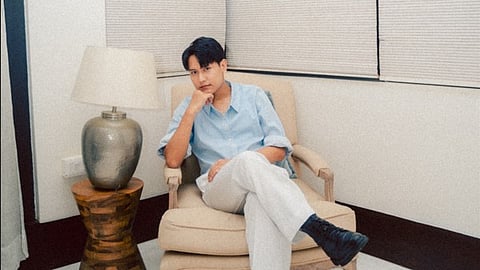
Musician Abdon Mech on his new EP, Not Overthinking This

Abdon Mech keeps his Naga foot forward while composing and signing his songs, and now he is back with his latest EP- Not Overthinking This. He speaks to Indulge about it, his inspirations, music festivals, and more.
Excerpts:
Tell us about your new EP and the songs in it.
My new EP is called Not Overthinking This. It is bilingual, with one song in the Sumi Naga dialect and three in English. It is essentially an indie pop record and has themes of love, heartbreak, slice of life, loss, etc in it. It was fully written and composed by me and recorded, mixed, and mastered by Kevi Pucho at Element Indie Studio, Nagaland.
What inspired the title of the EP?
In fairness, a lot of overthinking went into the record. I initially wanted to put them out as separate singles, then at one stage considered adding them all to a longer album for a full release. But I had written all these songs in the same season, and it only made sense to release them together right now. So the name was just influenced by the idea to stop overthinking and just put them out.
Did you approach this EP differently than your previous works?
Over the years, my sound has changed from an acoustic singer-songwriter setting to a more indie pop offering, and this record is the completion of that transition. I wanted to be bold, add more layers to my sound while still being absolutely honest and keeping my songwriting in the centre of things.
How do you think music is playing its part in taking the local languages to the global map?
Over the years, so many local languages from our region have made it to new spaces because of music. One example is my friend Taba Chake, who also writes in Nyishi, an Arunachali dialect. When he tours, it’s so cool to see his Nyishi songs being sung so loudly in new spaces all around the country by different people, and now he’s taking the same to Europe. He is a fine ambassador of the power of regional music. I’m trying to incorporate the same in my own way.
How did the making of this EP help you grow as a musician?
It made me more open to new ideas and layers. I’ve always wanted to keep my music simple and honest, but also keen to let it grow and evolve. Trying to balance its evolution while also keeping my roots intact was a challenge that I absolutely loved taking on. Another facet of my music is the live production front. So, writing and making this record while also keeping in mind how I’m going to be playing them live on a bigger scale was super fun.
How do you incorporate the tradition of Nagaland in your music?
We still hold traditional values and the simple way of life close to us. And I think a large part of that rubs off on my music too. When I was younger, my family lived in a simple bamboo house. My first record was called “From A Bamboo Room” because I wrote hundreds of songs in a literal bamboo room. Till today, my music comes from my small room and not big songwriting collaboration sessions or fancy studios.
How have Music Festivals in the NE impacted music in the region?
From a production perspective, seeing things scale up is exciting for the present and the future. The region has more than enough talent, just lacking in infrastructure and setting, which is now slowly growing. Also programming-wise, we can get bigger artistes to come to our festivals and share the stage with our regional acts. It has not only given value to the region commercially but also branding to our talented artistes, who have what it takes to take on the world.
Any musicians you take inspiration from?
Growing up, I listened to a lot of rock and roll like A7x, Nightwish, Queen, etc. But the formative years of my music were largely influenced by John Mayer. I started writing songs and playing the guitar because of him. Over the years, Bruno Major and Patrick Droney have also influenced my songwriting and sound. Of late, I’ve been listening to a lot of Lany and The 1975.
What would you want someone hearing your music for the first time to know about you through your music?
I try to be as honest as possible through my music; anything less would not feel reflective of who I am. The biggest compliment that I can receive as a songwriter/artiste is when someone can feel understood and comforted because of something I wrote in my room and, in turn, inspire them to live authentically as themselves.
What's next after this?