
- LIFESTYLE
- FASHION
- FOOD
- ENTERTAINMENT
- EVENTS
- CULTURE
- VIDEOS
- WEB STORIES
- SPORTS
- GADGETS
- CAR & BIKE
- TRAVEL
- SOCIETY
- GALLERIES
- NORTH EAST
- INDULGE CONNECT
For Mexican artistic director Jorge Díaz, mythology was woven into childhood as naturally as lullabies. While many families relied on familiar Western stories, his own bedtime repertoire leaned toward the Popol Vuh, the celebrated compendium of sacred Maya myths. Passed down to him by his grandmother, the tales connected him to his Indigenous heritage, and later, he shared the same stories with his son. One stood out above all others: the exploits of hero twins Ixbalanqué and Hunahpú, whose journey into the Maya underworld still resonates as a story of courage, trickery and renewal.
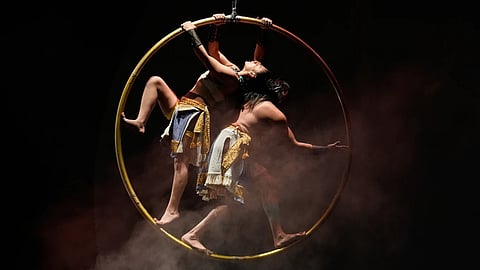
This enduring myth forms the heart of Díaz’s stage adaptation, Mortal Leap into Xib’alb’a, a production that melds circus arts with theatre to reimagine the twins’ descent into the underworld. Rather than presenting spectacle for its own sake, Díaz and his team focus on atmosphere, ritual and narrative. Acrobatics, aerial work and movement become extensions of character, emotion and myth, crafting a world where danger and transformation feel palpable.
The show first debuted in 2023 and continues to return to the stage, with recent performances held in Mexico City. Its evolution mirrors the artistic trajectory of its creators. The troupe behind the piece—Tránsito Cinco—was founded two decades ago by Díaz and fellow artist Jessica González. Originally trained in theatre, the pair began searching for a vocabulary that could fuse acting with dance, movement and heightened physicality. Circus, González recalls, became the point at which those artistic forms intersected, offering a discipline both expressive and dynamic.
Today, Tránsito Cinco’s body of work spans 16 productions, each with its own visual world and narrative spine. Although their themes vary, Díaz and González share a commitment to storytelling, believing that circus can communicate ideas, explore identity and even address social questions. Their working methods are documented in Somnia, a film exploring the company’s artistic philosophy. At a recent screening, director Arely Cantellano described circus as an art form that “opens doors to many different arts,” inviting audiences into a communal act of imagination.

Among the many layered elements of Mortal Leap into Xib’alb’a, the ritualistic dimension stands out. Díaz not only directs but also handles rigging, an essential role during high-risk acts. One of the show’s most striking performers, Yareli Reyes, takes on the role of one of the twins while suspended by her hair—an act that requires immense precision, strength and trust. Although Díaz originally hoped to perform one of the twins alongside his own brother, he stepped back to avoid taking on too much. Observing from a distance has given him a renewed appreciation for how circus can evoke the sacred. “When I’m holding the performer who does hair suspension,” he reflected, “there are moments when I see the light, the atmosphere, and it feels like a ritual.”
The performance carries the audience through the twins’ fantastical life cycle, beginning with their symbolic conception—when the skull of their father spits into their mother’s hand, passing life from death into the living realm. Raised among humans, the twins become skilled players of a pre-Hispanic ritual sport, provoking the ire of the Xib’alb’a lords and triggering a series of trials that lead to their demise. Yet the story’s power lies in transformation: the brothers ultimately return renewed, becoming the Sun and the Moon.
For Díaz, the myth encapsulates an understanding of death not as an end but as a cycle of rebirth—a theme he hopes resonates with young audiences, including the very child who once heard these stories at bedtime and is now 14. Through Mortal Leap into Xib’alb’a, Díaz aims to honour the complexity of Maya cosmology while inviting viewers to recognise how ancestral stories can find new meaning in contemporary performance.
“There are many elements from pre-Hispanic Indigenous traditions that can be brought into circus,” he said. “Ways to play with them, reinterpret them and let them speak again onstage.”
For more updates, join/follow our WhatsApp, Telegram and YouTube channels