
- LIFESTYLE
- FASHION
- FOOD
- ENTERTAINMENT
- EVENTS
- CULTURE
- VIDEOS
- WEB STORIES
- SPORTS
- GADGETS
- CAR & BIKE
- TRAVEL
- SOCIETY
- GALLERIES
- NORTH EAST
- INDULGE CONNECT

Kolkata, back in the days called Calcutta was a melting pot of culture and community. From the Portuguese, British, French, Scottish, Armenians to even the Greeks came to the City of Joy and settled down. Hereon, we explore one facet of the Greek community of Calcutta and how once even legendary filmmaker Satyajit Ray had a tryst with a monument, the Panioty fountain, with Greek roots.
It is said that the narrative begins around the mid-18th century when Panayiotis Alexandros (Alexander) Argyree became one of the first Greeks to have come and settled down in Bengal.
Who was the Panioty Fountain built as a tribute to?
Panioty, as we now know of it, is just an anglicised version of the name. Panioty was employed as a translator under the British captain Thornhill around the 1750s. Almost 20 years later, he is said to have undertaken a mission to Egypt under Warren Hastings, to secure British trading rights. For a long time, generations after him were in the trade, even going to Dhaka (Bangladesh) and returning to Bengal, until they slowly shifted towards roles under the British administration.
Born to this family, the son of Emanuel Panioty was Demetrius Panioty. Around the 1850s, when he was just a young lad of 16 years (approx.) he took up a job as a writer in the Bengal Secretariat. A few years later he received a transfer to the Durbar Department of the Governor-General’s Private Secretary Office. And he finally became the Assistant Private Secretary to the Viceroy.
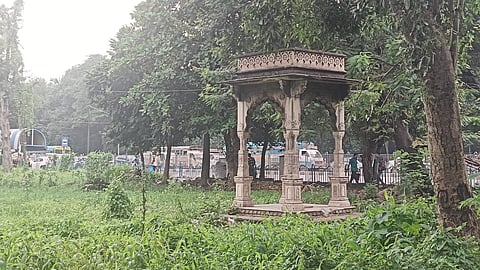
For his role in service to the Crown, he was also rewarded with the C.I.E. or the Companion of the Indian Empire. He started serving in the post since the time of Lord Ripon and continued to serve till his death in 1895 in Shimla. It is said that in memory of his outstanding contributions to the Empire, the Panioty Fountain or water tank was erected around 1898. Located at a very prime spot, and equally hard to miss, the Panioty fountain is situated right opposite Esplanade Mansion on one end of the Curzon Park.
Looking at the wonderful architecture
Although now dilapidated, one cannot deny the mesmerizing details and intricate carvings on this marbled water fountain. Made of Jaipur marbles with distinct Mughal-inspired architecture, this squarish structure is supported on four long pillars with a stepped base at the bottom. The rooftop has floral motifs in circular boundaries while the columns too depict the same.
What is interesting is the column base where the flowers and leaves, inevitably remind you of the intricate work done in the Taj Mahal. The actual water fountain, one can only imagine rested in the middle of the structure under an octagonal roof, but is no longer present today.
While the monument is said to have several inscriptions, the only one we could locate read- A good name is rather to be chosen than great riches.
The roof clearly indicates it was a resting place for travelers where they could stop to hydrate themselves and slow down in the tree-shades before continuing with their journeys.
In total neglect
Unfortunately, today the place is difficult to detect by those who don’t know the significant history of the monument. It lies in complete neglect with scribbles on different columns. Most of the intricate carvings are broken and destroyed. With years of direct contact with rains, ignorance, and sunlight without any proper maintenance, the marbles have started losing their colour.
Panioty Fountain's connect to Satyajit Ray
If this monument still doesn’t remind you of its connection with Satyajit Ray, then here’s making it clearer. Watched Parash Pathar? Ray’s iconic movie begins with a panoramic view of the rain-washed street where actor Tulsi Chakraborti is running to seek shelter and ends up under the shade of the Panioty Fountain.
Interestingly, the movie released in 1958 and one can try to backtrack its shooting to one or two years earlier, and the monument looks in better shape. Then what happened over the next six decades that led this important part of physical history and heritage to be neglected in this manner? Any passerby today would see men merrymaking around it, probably happily unaware of the piece of Bengal’s history it carries within its columns.
Suggestions for visiting
We would suggest you wear strong walking shoes if you want to explore the place. Be assured that you will have to wash your shoes when you return home after walking through the dense growth of grass. It is recommended that you avoid the place right after heavy rains if you notice waterlogging as the chances of slipping in the slime and mud are very high. Moreover, never approach it alone and after nightfall. Try to go in a group or with one more person.
For more updates, join/follow our WhatsApp, Telegram and YouTube channels