
- LIFESTYLE
- FASHION
- FOOD
- ENTERTAINMENT
- EVENTS
- CULTURE
- VIDEOS
- WEB STORIES
- SPORTS
- GADGETS
- CAR & BIKE
- TRAVEL
- SOCIETY
- GALLERIES
- NORTH EAST
- INDULGE CONNECT

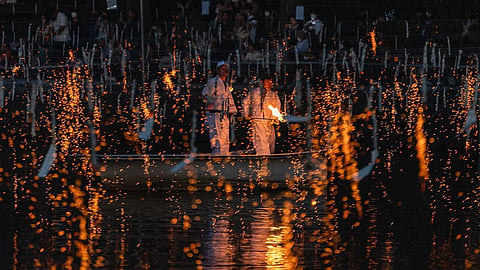
South Korea's Nakhwa Nori is a very poetic spectacle. Nakhwa Nori remains one of the country’s most mesmerising cultural rituals. It looks like thousands of glowing embers raining over a river in complete darkness, sparks floating like orange flower petals in the wind.
Nakhwa is a Korean word that has the double meaning of falling flowers or falling flames. Nori is a Korean word that means games, festivals, and enjoyment of the scenery. The flowers are not actual blooms, but glowing embers cascading from ropes strung above water. Traditionally, bundles made from charcoal powder and hanji (Korea’s durable handmade mulberry paper) are attached along long cords stretched across ponds or rivers. Once they are lit, the fire slowly burns downwards, and the sparks resemble orange petals drifting through the night.
In the Haman County, the annual Haman Nakhwa Nori event draws thousands of visitors every year in spring. Held around Buddha’s Birthday — usually in April or May — the event transforms the riverside into a curtain of falling sparks. This year the festival will be held at the Mujinjeong Pavilion in Haman County on May 24, 7 pm onwards.
The origins of the tradition trace back to Korea’s Joseon Dynasty. But the stories about its exact beginning vary depend from region to region. One popular account says local scholars and aristocrats created the event as a form of nighttime entertainment, others tie it to Buddhist rituals meant to ward off misfortune.
Nakhwa Nori slows everything down. The fire burns gradually, the crowd waits patiently and the beauty exists for only a few moments before disappearing into smoke and ash. The idea that fleeting beauty can be more powerful precisely because it does not last.
Today, the festival has gained international attention thanks to social media, travel photography, and the fascination with Korean culture beyond K-pop and K-dramas.
If you seek a different side of South Korea, one untouched by the glossy tourism campaigns, Nakhwa Nori is a glimpse into the country’s rich cultural background. It is ancient but alive, and beautiful without trying too hard — which, frankly, is the hardest thing any tradition can pull off.
For more updates, join/follow our WhatsApp, Telegram and YouTube channels.