
- LIFESTYLE
- FASHION
- FOOD
- ENTERTAINMENT
- EVENTS
- CULTURE
- VIDEOS
- WEB STORIES
- GALLERIES
- GADGETS
- CAR & BIKE
- SOCIETY
- TRAVEL
- NORTH EAST
- INDULGE CONNECT

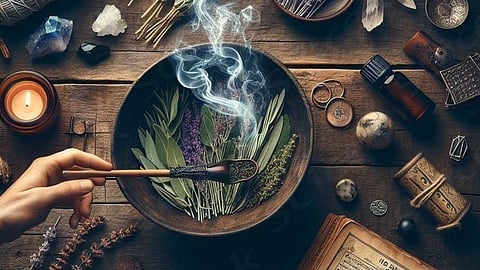
Do you burn or intend to burn sage around your house? If so, you might be curious to know if it really cleanses your space or not. Sage burning, or smudging, is different from burning incense.
Smudging is an indigenous practice, while incense originated in ancient Mesopotamia and Egypt. Incense is said to be one of the earliest known ingredients to create fragrance.
Th ancient practice of smudging, on the other hand, burns bundles of dried sage to create fragrant, herby smoke for spiritual cleansing and purification of a space, objects, or a person.
While sage is meant to purify a space or object, the primary function of incense is for fragrance.
Sage, which has a purifying fragrance, is said to purify spaces with negative energy and can be a great spiritual tool. Healers of some traditional cultures use it to create a "healing state."
This could be because of some elements in certain sages, like salvia sages and white prairie sage, contain thujone, which is said to be psychoactive.
Burning sage may purify and relieve symptoms of certain conditions. Some types of sage have antimicrobial properties, which could keep infectious bacteria, fungi and viruses away. It can also cure sleep disorders like insomnia.
A 2016 research project for the University of Mississippi suggested that white sage may have compounds that activate certain receptors in the brain. These receptors could elevate mood levels, reduce stress and pain.
Sage grows in the wild and is cultivated in countries like Italy, Albania, Turkey, and Spain. But it's not only used for purification purposes. It is also used in cooking.
It is a common ingredient in stuffings, sausages and other dishes, and has been used to treat various ailments. Moreover, it is often used as an ornamental plant for its pretty leaves and flowers.