
- LIFESTYLE
- FASHION
- FOOD
- ENTERTAINMENT
- EVENTS
- CULTURE
- VIDEOS
- WEB STORIES
- SPORTS
- GADGETS
- CAR & BIKE
- TRAVEL
- SOCIETY
- GALLERIES
- NORTH EAST
- INDULGE CONNECT
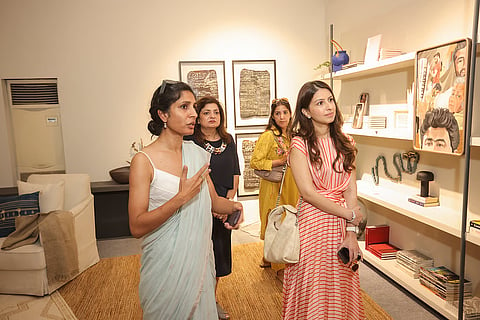
At Bikaner House’s LTC, art climbed bookshelves, slipped into wardrobes, settled in bathtubs, and even peered from the edge of a tailoring machine. This is ‘Taqiya Kalam’, curated by Priyanshi Saxena with Amrita Guha and Joya Nandurdikar of Untitled Design — a highlight of this year’s Delhi Contemporary Art Week (DCAW), which unfolded this weekend with six participating galleries.
The trio rebuilds the traditional white cube into a collector’s home, presenting art in a lived-in setting. It is less about displaying artworks and more about staging life itself. “One of the reasons why we created this space is because you are meant to hang around with the artwork,” Saxena says, explaining how the show dissolves the line between domesticity and display. Visitors are encouraged to sit on couches beside the paintings, flip through cookbooks, and even sample charcuterie arranged in corners with chips and dips. Labels and explanatory wall texts are absent by design. “We are too used to reading the wall before reading the visual. Here, I want people to learn how to read art itself,” she adds.
Bookshelves are fitted with cookbooks, political theory, catalogues, and photography books, their surfaces disrupted by framed canvases nailed directly onto the shelves — a way of challenging the neat separation between literature and visual art. “We treat books as food for the mind, and art as food for the soul — why must they be divided,” Saxena notes.
The preview, featuring artists from city-based galleries — Blueprint12, Exhibit 320, Gallery Espace, Latitude 28, Shrine Empire, and Vadehra Art Gallery — drew a steady crowd. Guests debated the works over champagne, drifted between rooms, or paused to listen to the acoustic performance staged outdoors by CCA.

Here are some of the presentations that caught our eye:
Queer intimacies in a bathroom
Artworks find their way into “low-status” spaces of the house like bathrooms, deliberately breaking the hierarchy that places the living room at the top of display culture. The bathroom, painted salmon pink, was reimagined as the site of queer intimacy with Sunil Gupta’s iconic photographs. Gupta’s series, Towards an Indian Gay Image, featuring Saleem Kidwai and the photographer himself, hung beside ‘Qutb’ on one wall. His Exiles series, including images at Jama Masjid and Jamali Kamali, was placed nearby. “I wanted to show his works in the bathroom, because his works are looking at intimacy,” Saxena explained, making visible the negotiations of queer desire in domestic and public space.
Mobile phones as monuments
The world is at war and we hear about it instantly, at the tip of our fingers. Much of our protesting, predicting, and finger-pointing happens through the same devices. In Moonis Ijlal’s ‘Lie Machine’ series of six canvases, framed in hand-carved borders mimicking mobile phones, aggression and violence are shown not only as reported through technology but also as gamified, consumed, and profited from. “The soldier is often not fighting for himself. War has always been business. Now data is part of that war,” Saxena notes.
Eccentric icons
On another corner, Bengaluru-based artist Indu Anthony presented ‘Cecilia’ed’, a photograph series of an octogenarian named Cecilia. In one frame, she smokes with pink flowers tucked into her hair. In another, she wears a shimmering violet dress, holding a tomato and sunglasses.
Anthony’s practice often explores women’s safety in public spaces; here, Cecilia becomes an unlikely muse. The photographs, taken in her home, blur the line between ordinary domesticity and staged flamboyance, with everyday objects like paint cans or her cat entering the frame. With Cecilia at the centre, Anthony disrupts normative notions of gender representation in public, while also poking at herd mentality and celebrity culture.
Violence recast
Represented by Shrine Empire is Bangladeshi artist Begum Tayeba Lipi, who has contributed sculptural works fashioned from razor blades, continuing her long engagement with the material. In her works, ‘I Am Old School’ takes the form of a pair of stilettos, while ‘Together’ resembles an iron and table. Lipi has long used blades to highlight issues of female identity and the history of violence, transforming the object long associated with both domesticity and danger into sculptures drawing from childhood memories of her brothers buying blades for the midwife.
Art as assertion
Blueprint12 highlighted the Aravani Art Project, led by artist Poornima Sukumar in collaboration with trans and cis women. Two works stood out: ‘Leisurely Saree’ and ‘Clap’. In ‘Leisurely Saree’ by Nandini, Kanchana, Varsha and Murugan, a woman drapes fabric around herself while two others look on. The scene, awash in bright reds and blues, celebrates joy and collectivity while simultaneously demanding visibility for trans identities in public space. In ‘Clap’, by artists Prarthana, Jyothi, and Hamsa Sriram, four women perform the traditional clap associated with South Asia’s transgender communities. The gesture functions as communication, assertion, and defiance.
Collective distortions
Ketaki Sarpotdar’s (Latitude 28) ‘There is no need for a hundred bees to get a hundred flowers to bloom’ stages a family seated in a circle playing “Chinese whispers” — children, parents, and grandparents pass a story along, textbooks and a flickering television at their side.
The work uses the game as a metaphor for the circulation of rumours and misinformation, each repetition distorting meaning further. By placing this within the familiarity of a family photograph, Sarpotdar underscores how collective narratives — even history itself can be reshaped through repetition and error.
DCAW this year is less about the singular object and more about experience. The reimagined setting asked viewers to sit with art, inhabit it, and confront it outside the frame of gallery convention. The show revealed a shared investment in how art engages with memory, identity, and social history — whether through the intimacy of Gupta’s photographs, the material urgency of Lipi’s blades, or the everyday humour of Anthony’s portraits.
On view at Bikaner House, Pandara Road, till September 4, from 10 am to 6 pm
This article is written by Adithi Reena Ajith