
- LIFESTYLE
- FASHION
- FOOD
- ENTERTAINMENT
- EVENTS
- CULTURE
- VIDEOS
- WEB STORIES
- SPORTS
- GADGETS
- CAR & BIKE
- TRAVEL
- SOCIETY
- GALLERIES
- NORTH EAST
- INDULGE CONNECT

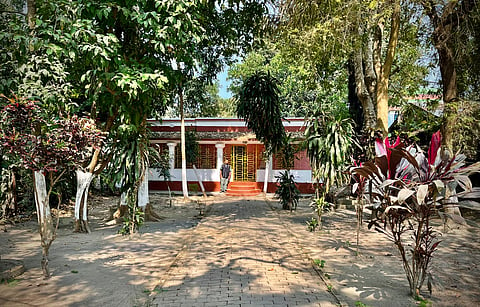
As we entered Aranya Bari, in Jodhpur Park, Kolkata, scenes from our childhood coming from the pen of Bibhutibhushan Bandyopadhyay flashed in front of us. Whether it was the iconic Apu-Durga scene around the Kashphool, seeing a train for the first time, immortalised by Satyajit Ray’s lens, or the adventurous Shankar traversing new paths among hills and jungles in search of his shining luck, all came together through Trinankur Banerjee’s artistic creations displayed at the ongoing pop-up at Aranya Bari.
While the merch was aesthetic and creative, there were layers of work behind it, the first being understanding and discovering Bibhutibhushan Bandyopadhyay, the environmentalist, more than the writer. We sat down with Trinankur, trying to unravel these layers from the past, discussing his work in the present, and the thoughts that he put together in keeping his grandfather’s legacy alive in the future.
When Trinankur begins by saying, "You would know the writer [Bibhutibhushan] from his books but would you imagine him as a youth on horseback carrying a gun. But that is him! And he writes about these in his diaries. He writes about how he went to hunt snipes on horseback, instantly regretted it, and came back." This very incident makes one feel the love he had towards nature that later gave rise to novels like Aranyak, and found reflection in his literry style.
Banerjee, who continues the family name in the third generation, has been working extensively in preserving the ancestral house of Bandyopadhyay in Barrackpore through various means. Although a resident of Delhi, he frequents the iconic house several times a year and has stepped in to preserve it for the future.
Talking about the right time he felt his intervention was needed he mentions, “I have been feeling that for quite some time now because the world is changing beyond our recognition and climate change is a major issue in contemporary world where its effects are felt in the smallest of things. Connecting it to Bibhutibhushan’s works, Aranyak is probably one of the first books to write about the environment, where the protagonist goes to clear a forest keeps on lamenting his work constantly. In reality, today we are blissfully unaware of the system but are also party to it. Not many people, after Bandyopadhyay have really celebrated the simplicity of living and life. So, I thought that we needed to bring back people to those basic tenets of life and practice simple living.” This he does through his designer-collection of utility products which draw elements from his grandfather's novels and also parallely restoring the ancestral house.
Going behind the scenes
Banerjee repeats that undeniably today's world is groppled by consumerism and that is how he can reach the audience as well, albeit his message through the collection would be 'simple living'. But the same was refletced through many big or small instances throughout the novels. So, how did he revsit them differently from when he read them earlier as a reader?
He opines, " When you are reading as a reader, and when you reading with a purpose to create something, both the approach and the purpose of the readings are very different. Half the time I didnt even know the vegetation my grandfather was mentioning, but I had to go and learn botany like him. I had to go back, and identify flowers like Adshaora or Kalkashunde, figure out their botanical names. These arent available readily in the city. I had to study and figure out Geography."
He continues, "When I was making a t-shirt around Ichamati, I had to look around the area and direction of the river. We often think Bibhutibhushan is a stream of consciousness writer; he is anything but. He is incredibly detailed but often we do not look at the details like he did. Since he made his writings so lyrical, we often overlooked how much research went behind each line."
Simple Treats
From fridge magnets, to luggage tags, from t-shirts to plates, from show pieces to bookmarks and more, in colourful , character-loaded motifs caught our eyes during the visit. Speaking about them he mentions, " My products are less polluting than other stuff and in the long run sustainable. I have tried to make it different for the Bengali users by incorporating North-Indian design aesthetics. My vehicle is artistic products which allows me to build something. If people use these products and constantly see the subliminal suggestions to be happy with the simple, they might consciously think about it. Moreover, we are in a society of consumerism so nothing better than products.”
Referencing Chander Pahar he says, “ Shankar traveled across land which had some of the most precious diamonds. But Bibhutibhushan does not reward his protagonist and instead gives him only 4-5 of them without any regrets. It is because he knows to have a lot doesnt necessarily mean one is content and happy.”
Back to the roots
No chat would have been complete without talking about the ancestral house of Bibhutibhushan Bandyopadhyay. What is more exciting for his readers and heritage enthusiasts is that the house is slowly being restored to preserve a very important piece of Bengali legacy. But this surely comes with its own sets of challenges.
Banerjee comments, " The house already has a lot of visitors every day. Say 10-50, and it grows over the weekends. Also, the house isn't in the suburbs. One has to travel well into the interiors of Bengal to reach it. This surprises me because he is incredibly popular and celebrated even today. The local relate their identity to him. Over the years, people - from near and far - visited just the house with nothing much to see in it. That made me think , that its my duty to set up something there. Say, even a set of posters with information. My goal is to eventually get actual objects used by him which at the moment is substituted with fascismili copies."
"Bandyopadhyay himself would have been very against ticketed entry to his house today and neither do I want so. that is the primary reason to introudce the products to crowd -fund restroration." However, more than that, this thought makes Bandyopadhyay truly a people's author where they play their part in giving back to maintaining his legacy.
With Bandyopadhyay's birth anniversary coming up tomorrow, Banerjee discloses the plan. " There will be a celebration throughout Spetmber 12-14. Setember 12 is his birthday, and September 14 marking his Bengali Birthday. Right now I'm setting up a series of posters, family photographs and all. Most people query about anything that they can take back home. Somethings that people can affordably purchase will be there. This year we will soft announce this."
Before signing off, he gave us anecdotes from the progress of the restiration," It takes a lot of time to set up and restore the house specially because the sense of time is slow. Also, the house where he grew up as a child, which is just two buildings away, is also in a dilapidated state. I am also trying to secure that place too. There are several human encroachments in the area, including people becoming visibly upset over not being able to graze their goats on that land. So, managing this is a continuous process, but I'm quite confident that in the next few years there will be more things to see.”
For more updates, join/follow our WhatsApp, Telegram and YouTube channels.