
- LIFESTYLE
- FASHION
- FOOD
- ENTERTAINMENT
- EVENTS
- CULTURE
- VIDEOS
- WEB STORIES
- SPORTS
- GADGETS
- CAR & BIKE
- TRAVEL
- SOCIETY
- GALLERIES
- NORTH EAST
- INDULGE CONNECT

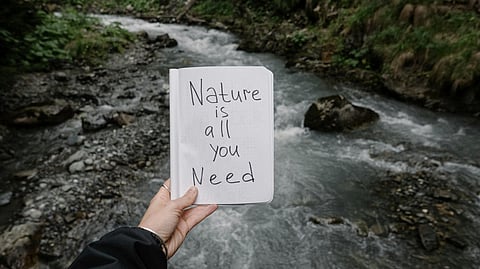
How many times while trying out forest journaling have you experienced a sense of deja vu? Every time you pick up a fallen leaf and try to identify it or see if it fits well within the structure of your journal page, do you get flashes of what you had been doing all along since childhood, except that it didn't have such a fancy name back then? Let's explore every time you have actually done forest journaling in various aspects without knowing that you have been forest journaling.
Let's start from the very beginning, remember when you were asked to pick up dried leaves, all in different shapes and sizes, so that you could draw them as a stencil and make art? Today, these leafy stencils are an essential part of journaling, which is then filled in with words, patterns, fabrics, and more.
Moreover, remember how you used to keep these leaves underneath a page and shade over them to get different textures? This forms a basic method of deriving different base textures for your journal page. Sometimes, hand-printed papers are also made using this method.
Another very popular use of these leaves was when the leaves as a whole were dipped in different colours and used as a stamp. Colourful, vibrant, and of different shapes and sizes, these gave a pop-colour look to scrapbooks, pages, and now journals.
Sometimes, multi-colour flowers were thrown in boiling water to extract the colours out of them and use them for painting. This process of eco-printing is now a very popular art and even finds practical usage outside a journal in the fashion industry and on the walls of art galleries.
Do you remember picking up fresh leaves, albeit ones which were fallen on the ground, painting on them, and writing personalised notes? Yes, leaves themselves can become the canvas at times and hold emotions and colours.
All these have been existing through activities at home or group activities during school art classes for a long time. And today, they get a transformed face through the arrival of the term forest journaling.
While forest journaling, in the truest sense of the term, includes scientific and statistical pursuits as well, one cannot deny that its very base, the collection of flora and fauna, has been a very popular and integral part of art and contemporary creative journaling.
For more updates, join/follow our WhatsApp, Telegram and YouTube channels.