
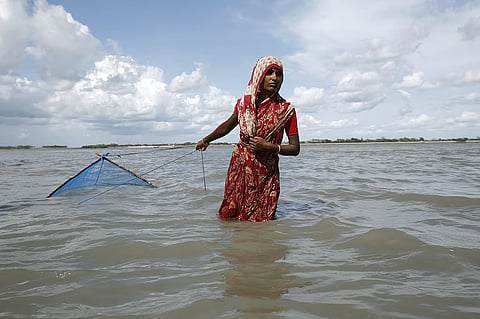
Amitav Ghosh's new novel Ghost-Eye returns to Bengal with a story about an identity crisis through fish
Not surprising for a place that has known man-made famines and hunger in its most visceral form, starvation and surplus are recurring themes in Bengal’s culture – both popular and high. At the centre of many of its books and films are children either with big appetites or starving; fat kings and merchants and thin animals; or monsters who like people for lunch.
Amitav Ghosh ’s Ghost-Eye (HarperCollins) adds to that library. His new novel is about almost a historical impossibility as a case study for hunger—the three-year-old daughter of the Guptas, a wealthy Marwari vegetarian family, who one day wakes up telling her mother she is not her mother, that in her past life she has eaten fish in the Sunderbans, and will give up eating unless she is fed some.
The Guptas seek the help of psychiatrist Shoma Bose, who has been investigating cases of reincarnation. What follows is a story set across different timelines and geographies -- from ’60s Calcutta and the Sunderbans to post-pandemic Brooklyn with a strong Burma connection.
Ghost-Eye is about many things, as Ghosh’s novels usually are. It is about endangered ecology, families, fate and scientific dogma, and also about food and marginalisation, and the way we relate to what is on the plate, and to each other. Excerpts from a conversation with the author on the worlds of connections he sets up and the way the past bleeds into the present.
Your work is Bengal-centric, you have written seven books about the region. But other than the fact of it being your hometown, what is it about Calcutta’s or, Bengal’s history that makes you keep returning to it?
Bengal, and particularly Kolkata, interest me in the first place because of my personal and familial connections. But they interest me also because of their rich and conflicted histories. Kolkata's colonial past, its position as the first capital of British India, its intellectual ferment, its riverine ecology, and its subsequent tragedies like Partition and the Naxalite movement create a landscape where the large forces of history—empire, capital, climate, migration—collide intimately with individual lives.
The city is a living archive of these collisions. I keep returning because these layers are inexhaustible; one can peel them back endlessly to find new stories. There is, for example, a very interesting story to be told about Girindrashekhar Bose, the pioneering Bengali psychologist who corresponded with Freud and actually challenged some of his ideas. In an early draft of the book, it is he who inspires Shoma to study psychology.
At the heart of Ghost-Eye is a delicious irony, a Calcutta Marwari kid with past life memories of being a Bengali and eating fish. That is really hardcore trauma. What made you think of such a premise for your novel?
Kolkata is as much a Marwari city as a Bengali one. The lives of the two communities are intimately intertwined and yet, in many ways, completely distinct. In some ways, Marwaris are even more attached to Kolkata than Bengalis are, because many of the most prominent Marwari families made their seed capital in Kolkata.
Both communities complain about each other, yet they cannot do without one another. As with any difficult marriage, this is a relationship that offers many imaginative possibilities, and what I have tried to do in this book is to explore one such possibility.
At first read, reincarnation may seem an old-worldly concept, but given that we are in the age of AI and of virtual avatars, you have kept reincarnation at its centre. Are you pointing to something deeper?
Today, many of the big names of the tech industry are obsessed with perpetuating themselves across time. Most of them think of doing this by uploading their consciousness into machines. But, of course, this quest is based upon the assumption that human existence is extinguished with death. But there are innumerable recorded instances that suggest that while the body may die, something lives on.
There are many case histories of children being born with very detailed memories of past lives. These cases force us to ask what exactly is it that lives on? What constitutes the continuity of identity? Is it memory? Is it sensory experience? These are some of the questions that animate this novel.
In a world suffused with the effects and strengths of science you are saying in this novel it doesn't have all the answers. In the book you have Pythagoras, a man of science, held up as someone who could recall past lives. Why do you think man’s inner universe, the soul, been underplayed by science, and what’s your personal position on reincarnation?
Science, for all its achievements, is a framework for understanding the external, material universe. It has been spectacularly successful there. But it has often been dismissive of interior or parallel universes. The figure of Pythagoras is a reminder that this was not always so. He was a foundational thinker in mathematics, a "man of science," who also fervently believed in metempsychosis—the transmigration of the soul.
As for my personal position, I am a novelist, not a guru or a scientist. Whether I "believe" in a doctrinal sense is less important than my belief that our current models of reality are insufficient to explain the entirety of human experience.

This phrase recurs in the novel with a single quote – ‘a case of reincarnation type’. Why?
The deliberate, almost bureaucratic phrasing—"a case of reincarnation type"—is how a rationalist, a doctor, or a sceptic might grudgingly categorise something that defies their taxonomy. Yes, Bengalis have a rich culture of stories about pretatma and punarjanma, from Ray’s wonderful Sonar Kella to countless folk tales.
After the publication of Ghost-Eye, innumerable people, including some very unexpected ones, have come forward to tell me about their own experiences with past life memories. But in urban, modern Calcutta, these experiences coexist with a thick layer of scientific rationalism and intellectual scepticism. The phrase is intended to capture that tension. It doesn’t fully endorse the concept, nor does it dismiss it. It places it in a parenthetical box, leaving the lid slightly ajar.
Why did you place fish at the book’s centre and say, for example, not kosha mangsho (goat curry)? Those who eat freshwater fish, will now not be able to think of doi maach (curd fish) without thinking of it as Labeo rohita or karvu....
Fish is not just food in Bengal; it is ecology, economy, identity, and a deeply embedded cultural code. By specifically naming the fish—Labeo rohita (rui), karvu—I wanted to root the memory in precise, biological reality. It’s not a generic "fish"; it is a specific being from a specific river. Fish are life, but they are also today markers of extinction and contamination. Goat meat does not carry that same symbolic riverine, ecological, and civilisational weight. The fish is a creature of the Ganga-Brahmaputra delta, of the very waters that shaped Bengal. To have a crisis of identity through fish is to have a crisis that is at once hydrological, historical, and deeply personal.
When will you write a Delhi novel?
Between the time that I lived there in the 1970s and 1980s, and now, it has become a megalopolis, and I no longer know it well enough to write about it. In fact, it has changed so much that I can hardly find my way around anymore.