
- LIFESTYLE
- FASHION
- FOOD
- ENTERTAINMENT
- EVENTS
- CULTURE
- VIDEOS
- WEB STORIES
- SPORTS
- GADGETS
- CAR & BIKE
- TRAVEL
- SOCIETY
- GALLERIES
- NORTH EAST
- INDULGE CONNECT
In an age of quick recipes, cloud kitchens and algorithm-driven food trends, Crescentia Scolt Fernandes’ A Tale of Two Kitchens moves deliberately in the opposite direction. It is not a book chasing novelty, but memory—of kitchens where time was elastic, of dishes made for festivals rather than followers, and of flavours that now survive mostly in recollection.
Released recently, the book is part memoir, part culinary archive. It traces Fernandes’ journey through food shaped by an unusually layered ancestry—Dutch, Portuguese, Anglo-Indian, Goan and even Chinese—while documenting recipes that are quietly slipping out of everyday kitchens.
“I wanted younger people in the family to at least know what we ate as children,” Fernandes says. “Nobody makes these dishes now. Maybe if they read about them, they’ll try to preserve at least a few.”
Food that time forgot
At the heart of the book is a concern that has less to do with changing tastes and more with changing lives. Fernandes believes traditional dishes haven’t disappeared because they are unpopular—but because they are time-consuming.
“Our mothers didn’t work outside the home,” she says. “They had time to make breakfast, lunch, evening tea and dinner. Today, nobody has that luxury.”
Among the dishes she documents are ones that are now nearly extinct within her community. Two stand out. One is a Dutch-origin bread-cake Breudher, a cross between a loaf and a celebration bake, once made for religious occasions. Traditionally fermented with toddy—long before commercial yeast was common—it is now produced by only a handful of bakeries.
Fernandes spent years testing versions of the recipe, until the texture finally matched her memory. “If you live outside those places, you can’t get toddy. So you adapt,” she says. “The idea was to get it to taste like what I remembered.”
The second is Poffertjes, a shallow, pancake-like cousin of the paniyaram. “We had just one pan that went around between families,” she recalls. “Some of my younger cousins don’t even remember what it is.” Easy to make, yet rarely made anymore, it represents the quiet erosion of food traditions—not through resistance, but neglect.
A mixed kitchen
Fernandes’ relationship with food was shaped less by rigid tradition and more by curiosity. Her mother, progressive for her time, experimented widely—learning recipes from British magazines, Muslim neighbours, club kitchens and visiting foreigners. “We didn’t have ‘typical’ food at home,” Fernandes says. “It was always mixed.”
That openness reflects in the book, which moves fluidly between Vypeen, Kerala where she spent her childhood, to Goa and beyond which are similar yet different in their own ways. Portuguese colonial dishes like bibingka, found across former Portuguese settlements, appear alongside coconut-heavy coastal curries. While Kerala relies on kodampuli (Malabar tamarind) for sourness, Goan kitchens use kokum—often confused as the same ingredient, but distinctly different.
“People call both kokum,” Fernandes points out. “That’s wrong. They’re different fruits, used differently.”
Still, fish curry rice remains the shared comfort—across geographies and generations. “Whether it’s Goan fish curry or the way my mother made it, that’s home food,” she says.
‘I was considered useless’
Ironically, Fernandes didn’t grow up cooking. “I was considered the useless one,” she laughs. “I didn’t learn anything from my mother or grandmother.” It was only after marriage—and necessity—that she learnt to cook, starting from scratch: rice, dal, aloo-gobi, asking colleagues for instructions and watching her mother-in-law.
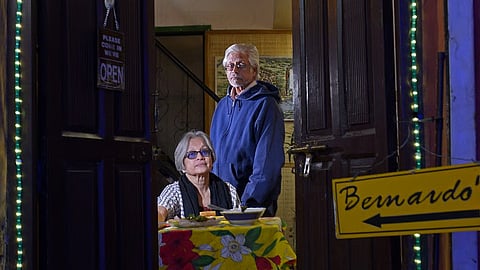
That slow, practical education eventually led to an unlikely turn—entrepreneurship. What began as a pickle-making business in the mid-1990s grew into Bernardo’s, her Anglo-Indian-Goan restaurant in Delhi, named after her father-in-law. Run like an extension of her home kitchen rather than a commercial operation, the restaurant became known for dishes like stuffed prawn risada and fish curry rice.
Over the years, Bernardo’s moved eight times through Delhi-NCR, surviving through trial, error and sheer persistence. “You learn about scaling, standardising, wastage—things no home cook thinks about,” she says.

Writing during the pause
The book itself was born during the pandemic. “Covid-19 gave me time,” Fernandes says simply. Years of people asking for her recipes finally culminated in a written record—not to commercialise them, but to safeguard them.
“Even if you give someone the recipe,” a chef once told her, “everyone’s hand is different.” Fernandes agrees. A Tale of Two Kitchens is less a manual than a memory map of food that deserves to be remembered, even if it is not cooked every day anymore.
In preserving these recipes, Fernandes isn’t chasing revival for revival’s sake. She’s offering something quieter: a chance to remember where flavour once came from, and why it mattered.
This article is written by S Keerthivas
For more updates, join/follow our WhatsApp, Telegram and YouTube channels.