
- LIFESTYLE
- FASHION
- FOOD
- ENTERTAINMENT
- EVENTS
- CULTURE
- VIDEOS
- WEB STORIES
- SPORTS
- GADGETS
- CAR & BIKE
- TRAVEL
- SOCIETY
- GALLERIES
- NORTH EAST
- INDULGE CONNECT
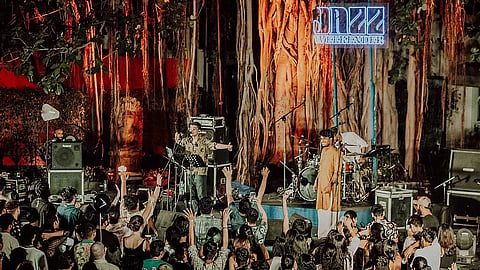
October kicks off on a festive note, and for Delhi’s jazz lovers, this weekend promises pure rhythm as Jazz Weekender returns for its fourth edition on October 11 and 12 in Mehrauli.
This year’s lineup brings 10 artists from across the world—from Australian singer-songwriter Allysha Joy’s soulful lyricism to jazz pioneer Mark de Clive-Lowe’s India debut with an improvisational live set. From India, Ahmedabad rapper Dhanji leads a 13-piece band that fuses rap-funk with jazz, while the quintet Sambucáda from Goa blends jazz harmonies with Brazilian samba and bossa nova.
“Nowadays, everybody is going after the headliner,” says Tanish Thakker, co-founder of Jazz Weekender. “We’re not chasing big names. Our idea is to present multiple headliners—artists who may not be massive yet but are exceptional in their craft. There’s so much unexplored jazz talent in India, and we want to give them a space to shine.”
Started in 2022, Jazz Weekender—curated by music collectives boxout.fm, Wild City, Gatecrash, and Jazz in India—was envisioned as a home for jazz in all its evolving forms, from classic swing to electronic and rap-jazz fusion. “It’s a space that celebrates both the classic ’70s and ’80s sound and the new-age jazz scene,” Thakker adds. “It’s not just about nostalgia, it’s about what jazz can become next.”

But the festival is not all about the music. The festival’s charm also lies in its easy, outdoor setup. “We wanted to bring back the idea of music as a shared experience—a picnic, a conversation, something you enjoy with your friends and family in nature. It’s more intimate, more grounded than large-scale productions,” says Thakker.
For the performers too, Delhi feels like new ground. “It’s been in conversation for a long time, so the fact that it’s all finally happening—I feel incredibly grateful,” says Allysha Joy, whose debut India performance will feature tracks from her album Solina (2025) as well as songs from her 2024 release The Making of Silk, alongside new material. “Before any music is performed, there’s always a conversation around intention. My music is about healing and creating a calm presence for myself and the listener,” she adds.
New Zealand musician Mark de Clive-Lowe based in Japan, known for exploring themes of belonging and identity, calls his set an act of “live remixing”. His Delhi performance marks his India debut, and he says he’s excited to see how the audience responds to his sound. “Every performance is improvised and shaped in the moment—the space, the crowd, the energy all feed into the sound,” he shares.
Meba Ofilia, one of India’s most exciting hip-hop and R&B voices, also makes her festival debut this year. Shillong girl Ofilia promises a set that “blends the warmth of soul, the pulse of hip-hop, and a sprinkle of jazz”. She adds, “It’s my first time performing in Delhi, and I hope people walk away not just entertained, but feeling like they got to know me a little—through the lyrics, the pauses, the stories.”
Her set will bring together audience favourites like ‘Done Talking’—her collaborative track with Khasi Bloodz that won the MTV EMA Best India Act in 2018—which she says “will always be part of my set because it’s where a lot of people first found me”. She’ll also bring to stage, songs from her 2022 album untitled.shg, reimagined with live instrumental sections that weren’t part of the studio versions. Ofilia also hints that her Jazz Weekender performance will also feature new, unreleased tracks that “hint at where I’m going sonically next”.
With the fourth edition set to begin today, Thakker says he’s already looking ahead to taking the festival beyond Delhi, starting with Mumbai next year. “We’re a boutique, niche festival—we’re not trying to become massive,” he says. “But the idea is to grow by taking Jazz Weekender to multiple cities. In an ideal world, I’d love for us to have multiple stages so we can showcase even more Indian artists, because there’s so much talent here waiting to be heard.”
Jazz Weekender begins today at 1AQ, Mehrauli from 2pm onwards. Tickets available online.
This article is written by Adithi Reena Ajith