
- LIFESTYLE
- FASHION
- FOOD
- ENTERTAINMENT
- EVENTS
- CULTURE
- VIDEOS
- WEB STORIES
- SPORTS
- GADGETS
- CAR & BIKE
- TRAVEL
- SOCIETY
- GALLERIES
- NORTH EAST
- INDULGE CONNECT

Dharangaon is barely recognisable. The stone mansion that once gave the Wada Chirebandi trilogy (a set of three Marathi plays by playwright Mahesh Elkunchwar) its name — the anchor of an entire family — now stands as a decaying building. Torn walls, broken-down houses, vultures overhead, animal carcasses, water in meagre quantities. The village itself has hollowed out; people have died, others have migrated. What remains is dust, a gruelling sun and the last few members of the Deshpande family.
“I first encountered the Wada Chirebandi trilogy almost a decade ago and it left a lasting impression on me. We’ve approached the play with the idea to mirror the disintegration within its world. As the landscape becomes barren and stripped of life, relationships and the urgent philosophical questions drive the characters,” Gerish Khemani, director, begins.
Yugant is the third and final part of the trilogy, which follows the Deshpande family across generations. The first two parts, Wada Chirebandi and The Pond, established the family in their village of Dharangaon, Maharashtra, at a time when the household was still populous and the mansion standing tall. Yugant arrives nearly a decade later and what it finds is an ending. Director Gerish Khemani brings the play’s Hindi adaptation to life with Ajinkya Ovhal, Barkha Fatnani, Hrishabh Kanti and Jaymin Thakkar.
“This is not a plot-driven play in the conventional sense. In many ways, the world of Yugant doesn’t feel distant. With climate change, rising temperatures and looming concerns around water scarcity, especially in our country, the apocalyptic landscape of the play feels eerily plausible. At the same time, the play isn’t just about collapse. It’s about how human beings respond to it. How do we find meaning? How do we continue to live, to hope, to relate to each other when everything around us seems to be disintegrating? That’s what makes it feel urgent today,” he reveals.
Only three Deshpandes remain at home: Parag, his wife Nandini and their son Bal. The play begins when Abhay, a cousin who has spent years in Sweden, returns to visit. His arrival brings the family together for what becomes less a reunion and more a reckoning: the cousins talk, argue and sit with questions that have no clean answers — about the life they have each chosen, the ties that bind them to a place and a people and what kind of world they are leaving behind for the next generation.
“Yugant works as a fairly self-contained piece. While there are echoes and resonances from the earlier plays, the audience quickly gets a sense of a once-thriving household that has now fallen into ruin. At one level, it’s a reunion after nearly a decade — so there’s a natural process of catching up, of seeing how each other’s lives have unfolded. But beneath that, the intervening years have hardened them, making them both familiar and unrecognisable,” he tells us.
Abhay is more scientific, skeptical and somewhat alienated, while Parag is instinctive, emotional and deeply rooted in his environment. Their unfinished business lies in this divergence — how they understand the world, how they cope with it and how they, in a way, help each other make sense of it again. Nandini witnesses all of it, steady and largely silent.
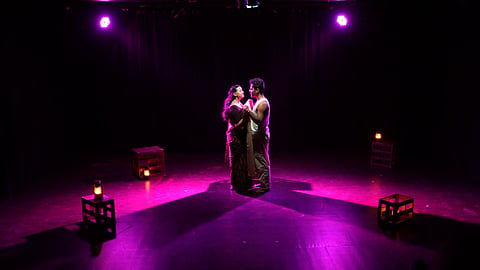
“The play leaves you with a very fundamental question: how does one find meaning and hope when the world around seems to be falling apart? We’ve approached the environment through suggestion rather than realism. The stage is deliberately minimal, almost skeletal. Through lighting, spatial compositions and the physical distance between actors, we evoke a sense of barrenness and emptiness. We’ve used earthy, dust-laden tones, browns and muted shades that reflect the barren landscape. There’s also a sense of limitation in what the characters wear. It feels like they have very few possessions left, perhaps just one or two sets of clothes, which speaks to their circumstances,” he shares.
₹300. May 16, 3.30 pm & 7.30 pm. At Rangashankara, JP Nagar.
For more updates, join/follow our WhatsApp, Telegram and YouTube channels.