
- LIFESTYLE
- FASHION
- FOOD
- ENTERTAINMENT
- EVENTS
- CULTURE
- VIDEOS
- WEB STORIES
- SPORTS
- GADGETS
- CAR & BIKE
- TRAVEL
- SOCIETY
- GALLERIES
- NORTH EAST
- INDULGE CONNECT
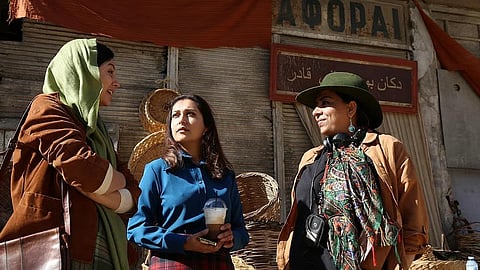
The October chill was just setting in and as the evening turned to night, the audience eagerly waited to view celebrated award-winning Afghan woman Director, Roya Sadat's latest film Sima's Song in Delhi’s Max Mueller Bhavan. Roya, like many women filmmakers, journalists and activists in Afghanistan now lives in exile in the West and made this film in 2024 while in exile. Sima's Song begins after the Taliban have taken control of Kabul city. It zeroes in on a protest demonstration on the streets by Afghan women and the Taliban forces using force and trying to disperse them.
Cut to the interior of a home in Kabul. An elderly Suraya tells her granddaughter about her friend, Sima, a singer. The grandmother recalls the Cold War which was about to break out in Afghanistan in the late ’70s, and how she and her friend Sima got caught in the opposing ends of the conflict.
Suraya is played by award winning actor Mozhdah Jamalzadah, an Afghan Canadian singer, actress, model, and activist known for championing women‘s rights in Afghanistan. Raised in Vancouver after fleeing Kabul during the Afghan civil war, she gained fame with her song 'Sher Bacha e Afghani'. Niloufar Koukhani who plays Sima in the film is a renowned Iranian actor best known for her roles in popular TV serials in Iran such as Viper of Tehran (2024), a TV series. Sadat has extracted powerful performances from both the lead characters.

Flash back to 1979, Kabul. Suraya and Sima are in the prime of their youth. Despite the difference in their social status – Suraya is the daughter of a top Communist leader in Afghanistan and Sima is the daughter of the domestic help in their house – both women are soul sisters. Suraya studies politics and Sima music at the university of Kabul. But the country's unstable political landscape is soon about to cause deep chasms between them.
Suraya takes on a political mantle after her father's assassination and Sima succumbs to pressure from her father to marry and follow tradition. The tension threatens to rip apart their relationship but better sense prevails and they decide to accept differences and save their bond. Suraya puts aside her annoyance that her friend is marrying early and gets her bridal dress ready. After all they do share the same conviction to women‘s right to education and art.
In the backdrop, Afghanistan is on the boil. Spies, assassinations, betrayals abound. Sima and her husband Wahab start attending meetings of the Muslim Youth, who oppose the Communist regime. Sima and Suraya are now clearly on opposite sides of the political divide. The reprisals against the Muslim Youth results in Sima's father being killed at which point Suraya helps Sima and her husband to escape to the mountains to the mujahideen. But very soon Wahab is killed and Sima is arrested and tortured for information. Meanwhile in Kabul the opposing factions within the Communist Party are in a power struggle and soon murder, imprisonment, and exile face Suraya’s comrades. Suraya is arrested and interrogated on Sima and the mujahideen’s whereabouts.
A very poignant line in the film goes like this. Suraya is being advised by another woman politician 'You must leave the country to be safe'. Suraya replies—"We can't all leave".
The woman politician replies: "We can't all die". Suraya stays back and pays a heavy price. Sima and Suraya are reunited in prison. But it is too late. They realise they have just been pawns in the hands of two opposing groups who were only hungry for power. Suraya holds Sima in her arms through the night until Sima's dying breath.
Cut to 2023. Suraya’s granddaughter now holds Sima’s Rubab. Suraya plays a tape of Sima singing a song by the Persian poet Rumi. The director cuts to shots of Afghan women, demanding their rights. In fact, even as we spoke of hope at the Max Mueller Bhavan premises, a stone's throw from us the Taliban Foreign Minister Amir Khan Muttaqui had held a press conference that very day at the Afghanistan embassy in New Delhi and barred the entry of women journalists into the presser. This led to an uproar in India and the minister had to hold another press conference the following day where women journalists attended. “India is one of Afghanistan's closest friends ..and we want the Indian government to speak out for the rights of Afghan women which are being snatched from them", Roya pleaded from exile.
At a post-screening conversation with director Roya Sadat who joined me online from Canada where her film Sima's Song had just won an award at the International Film Festival of South Asia in Toronto, Canada , she walked us through the challenges of filming in exile.
On making the film in exile
“The movie was meant to be shot in Afghanistan but with the Taliban taking over, I found myself suddenly in exile and the whole production had to move to Europe and had to take on many complex immigration challenges. At the time of the filming, there was an exodus from Afghanistan and we scoured many refugee camps to find the actors from across Europe. The filming was done in Greece and while through the refugee camps, several actors were chosen, they were also getting resettlement visas to other countries so there was a constant flux as actors left and had to be replaced. This was fortunate for them but unfortunate for us. There was also the funny problem of trying to get donkeys for the shoot ...”
According to media statistics, around 8000 journalists have left Afghanistan since then, of whom around 2000 are women journalists. On dealing with the invisibilisation of women journalists, women artists, and women filmmakers in Afghanistan since the Taliban walked into Kabul in mid-August 2021.
“It is tragic for me personally to be winning awards while in exile and being unable to share this with my own community. I am so happy that this screening has provided me that space to reconnect with my own community. As our voices are being suppressed, it is all the more reason that we must be louder. As filmmakers, as artists, it is critical that we use any medium to tell these stories. And finally, we live in hope that one day things will get better.”
Her next film
'I want to make a comedy next...'.she says . For a moment the heavy mood in the audience lifts and everyone smiles. This is a good moment to invite her husband, Aziz Deldar ,who is her screenplay writer on the call to say hello to everyone. In 2024, they made two films - Sima's Song and The Sharp Edge of Peace which her sister Alka Sadat , who also lives in exile, produced. These women Afghan filmmakers despite fighting heavy odds, are truly on fire.
Roya and Aziz both dream of returning to her country one day where women will once again go to school, university and work in public places. Just like the women in the rest of the world.
(Written by Nupur Basu)