
- LIFESTYLE
- FASHION
- FOOD
- ENTERTAINMENT
- EVENTS
- CULTURE
- VIDEOS
- WEB STORIES
- SPORTS
- GADGETS
- CAR & BIKE
- TRAVEL
- SOCIETY
- GALLERIES
- NORTH EAST
- INDULGE CONNECT
A new exhibition unveiled alongside this year’s Met Gala turns its focus to the human body — not as an idealised form, but as a site of reinterpretation. Titled Costume Art, the show at the Metropolitan Museum of Art’s Costume Institute examines how bodies have been styled, framed and, in many cases, overlooked across art history.
Visitors are first met with a striking visual: a gold-sequinned Dolce & Gabbana column gown depicting Aphrodite, the Greek goddess long associated with classical beauty. The figure stands poised, holding a golden apple — an enduring symbol of aesthetic perfection. Yet, rather than reinforcing that ideal, the exhibit uses it as a starting point to question it. Curator Andrew Bolton describes the approach as an attempt to “reclaim the body”, shifting attention towards forms historically excluded from dominant narratives.

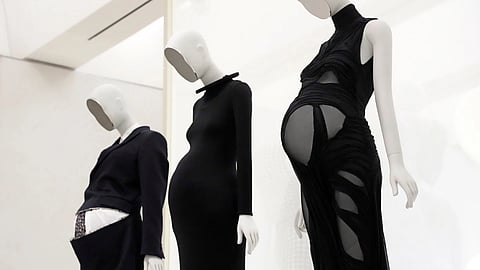
Spanning centuries, Costume Art pairs fashion garments with artworks, suggesting an ongoing dialogue between the two disciplines. The opening gallery, Bodily Being in its Diversity, begins with Grecian-inspired drapery before moving towards bodies that have often been marginalised — pregnant, ageing, disabled and larger bodies. The transition is gradual but deliberate, charting how representation expands when conventional ideals are set aside.
The pregnant body, frequently hidden or stylised in visual culture, is foregrounded through pieces such as Georgina Godley’s 1986 “Bump and Lump” dress, which accentuates the expectant form rather than disguising it. Nearby, works by artists like Edgar Degas offer a rare historical counterpoint, presenting pregnancy as both physical and introspective.
Elsewhere, designer Michaela Stark’s corsetry challenges assumptions around size and form. Rather than minimising the body, her garments emphasise flesh and contour, reframing them as sites of expression. These pieces are displayed alongside historical artefacts that echo similar shapes, suggesting that such bodies have always existed, even if they were not always centred.
A substantial section of the exhibition is devoted to disability, presented not as absence but as variation. Mannequins based on individuals including Aimee Mullins and Sinéad Burke introduce garments that integrate prosthetics and adaptive design. In one instance, prosthetic limbs are fashioned as sculptural boots, blurring distinctions between function and ornament. Another display reworks a trench coat to suit a different physical scale, highlighting how design can adapt to diverse needs.
The exhibition also considers less visible conditions. A coat by Nadia Pinkney, inspired by familial experiences with Alzheimer’s, incorporates patterns derived from brain scans, offering a material interpretation of memory and loss. Paired with artworks influenced by similar experiences, it extends the conversation beyond the immediately visible.
The second main gallery shifts focus from diversity to shared human conditions — ageing, mortality and the body’s internal processes. Ageing is reframed as a form of sophistication rather than decline, while other displays explore the physicality of the body in more visceral ways.
By bringing together fashion and art, Costume Art proposes that both mediums shape how bodies are seen and understood. In doing so, it raises a broader question about representation — not only who has been visible, but how that visibility has been constructed over time.
For more updates, join/follow our WhatsApp, Telegram and YouTube channels.