
- LIFESTYLE
- FASHION
- FOOD
- ENTERTAINMENT
- EVENTS
- CULTURE
- VIDEOS
- WEB STORIES
- SPORTS
- GADGETS
- CAR & BIKE
- TRAVEL
- SOCIETY
- GALLERIES
- NORTH EAST
- INDULGE CONNECT

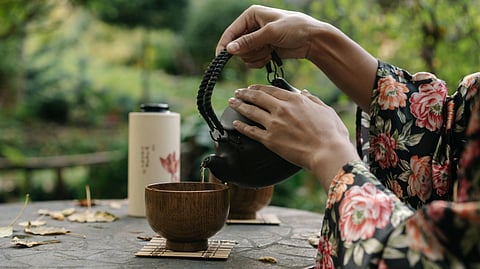
For the Japanese, eating food or drinking beverage is not just an activity which takes a few minutes of your life. It’s an activity connected to deep philosophical meanings and needs to be relished in its own time. You would probably never find people grabbing food-on-the-go because they prefer to sit back, relax and eat, stress-free. Similarly, they love their tea and it’s a full fledged Japanese tea ceremony, which needs to be enjoyed in every step. Here’s all that you need to know about the Japanese tea ceremony, in case you would like to experience it in person as a tourist or get invited to an acquaintance’s house for the same.
The Japanese tea drinking ceremony is nothing short of art unfolding step-by-step. In local language, it is called Chado or Sado, which means The Way of Tea. A beautiful blend of spirituality, hospitality and aesthetics contribute to the Japanese tea ceremony where one prepares the matcha and enjoys every process.
The philosophy of tea-drinking
Before taking a look at what goes in the actual ceremony, one needs to know that the entire Japanese tea ceremony rests on four pillars of philosophy. Wa means harmony between the people and their surroundings. Kei amounts to respecting even the smallest things like the utensil in which one blends the tea. Sei refers to achieving purity of the body, heart and the surroundings while Jaku means tranquility which is a result of mindfulness. These four pillars form the base of zen philosophy.
Delving into origins
Interestingly, the Japanese tea ceremony has its roots in China, where in zen monks in the 12th century brought matcha from. Almost three centuries later it was Sen no Rikyu who had perfected this art of Japanese tea ceremony incorporating the wabi sabi principles. Moreover, as time progressed, different schools of tea ceremonies sprang up like Urasenke or Mushanokoji-senke. However, no matter which school with its subtleties one experiences, the Japanese tea ceremony is one that is to be cherished for its philosophy, simplicity and perfection in imperfection.
Japanese tea ceremony: What does it hold?
The ceremony itself has five simple steps. First, choose the perfect space to host the ceremony. This space called the Chashitsu is often a peaceful garden or a minimalistic room in a house. Second, everyone, including the host and guests have to clean their hands and mouths before entering the designated space. This refers to purification. Moreover, the entry to the space is always through a low door which means one has to bow in humility and thanksgiving before being a part of the ceremony. Second, observe the tea-making utensils which are the tea bowl or chawan, bamboo whisk or chasen, bamboo tea scoop or chashaku and a tea caddy or natsume. Each of these utensils are carefully chosen and reflects the choice of the host. Third, is the actual ritual of serving tea where the utensils are cleaned in front of the guests and the tea is made by pouring hot water and whisking matcha powder. Guests are required to bow, rotate the tea bowls and drink it quietly. To conclude the ceremony, the guests not only appreciate the tea but also thank the hosts for organizing the ceremony.
For more updates, join/follow our WhatsApp, Telegram and YouTube channels.