
- LIFESTYLE
- FASHION
- FOOD
- ENTERTAINMENT
- EVENTS
- CULTURE
- VIDEOS
- WEB STORIES
- SPORTS
- GADGETS
- CAR & BIKE
- TRAVEL
- SOCIETY
- GALLERIES
- NORTH EAST
- INDULGE CONNECT

With the world spiraling fast towards consuming healthier food choices, many have started replacing sugar with natural sweeteners like jaggery. But here’s the catch, jaggery is also of various types and the source product determines if the jaggery is truly a healthy replacement to sugar or not. When it comes to talking about jaggery, there’s the regular version and many others derived from the sap of date palm, coconut trees and more. Here, we take a look at the nuanced differences or similarities between coconut and regular jaggery.
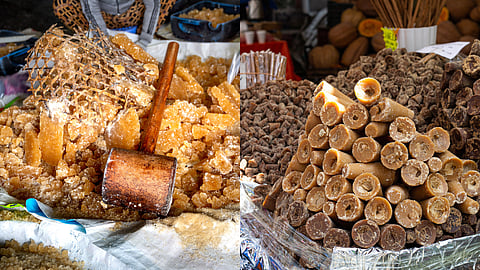
While both of them are jaggery, the two come of completely different sources, which impact their make, texture, nutrient composition, taste and more. Coconut jaggery, as the name suggests, comes from the coconut palm flower sap while regular jaggery can be traced down to sugarcane stalks. The former has a mild caramel flavour and the latter has a distinct rustic flavour. Coconut jaggery is often granular in texture and thus, they can be used for filling of sweets, while the hard or powdered regular jaggery is either used as a sweetener or melted to form a puree before using. Though both of them are more or less a similiar brown in colour, coconut jaggery is slightly less sweet than regular ones.
How are coconut and regular jaggery made?
Both follow the same process of making. The only difference lies is that on one hand sap collected from coconut palm trees is boiled, while on the other sugarcane juice is boiled. Once, either is free of the natural moisture, the thick residue left behind is either directly consumed as liquid jaggery, or solidified into blocks, or pounded into granules for consumption.
Is coconut jaggery healthier than regular jaggery?
Health enthusiasts have to agree on the fact that coconut or regular jaggery is definitely less sweet than processed sugar. But, one cannot oversee the fact that both are made from naturally sweetening sources and therefore do contain a high amount of natural sugars. Coconut jaggery comprises zinc, iron, potassium, and magnesium; is not chemically refined, and depending on its making process, might indicate a lower glycemic index. However, it still has sucrose, glucose and fructose – the sugar producing compounds in them, making it taste just as sweet as regular jaggery.
Thus, if you are looking for healthier choices, you can make do with either of them. But a lot of it depends on the quality and quantity of consumption. However, the difference actually lies in using them for the colour, texture, and flavour. This makes coconut jaggery a choice among bakers while regular jaggery is the crowd favourite among traditional sweet makers.
For more updates, join/follow our WhatsApp, Telegram and YouTube channels.