
- LIFESTYLE
- FASHION
- FOOD
- ENTERTAINMENT
- EVENTS
- CULTURE
- VIDEOS
- WEB STORIES
- SPORTS
- GADGETS
- CAR & BIKE
- TRAVEL
- SOCIETY
- GALLERIES
- NORTH EAST
- INDULGE CONNECT

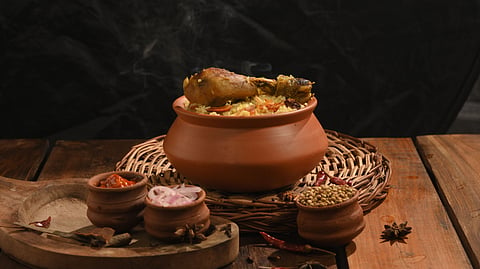
Indian cuisine has always been dependent upon time and spices to create taste. But there has been nothing more unique than the Dum Pukht style of cooking. This biryani cooking process takes place over slow fire, whereby food items are cooked in a heavy pot until all the aroma, juice, and spices are mixed up. The Dum Pukht cooking technique is still widely followed in food items such as biryani and slow-cooked meat curries.
The Dum Pukht cooking technique is based on two fundamental principles. First, dum pukht cooking requires low heat, and secondly, a closed container is used to prepare the food. Food is prepared in a heavy-base pan known as a handi and closed by making dough around it so that steam does not come out. As a result, the food cooks in its own juice.
The Dum Pukht cooking technique has its origins in the Mughal kitchen. It is said to be influenced by the Persian and Central Asian cooking methods. This method of cooking came to fame in Awadh towards the end of the 18th century during the time of Nawab Asaf-ud-Daula. The large sealed pot was used to serve the labourers while building the Bara Imambara in 1783.
In this method of cooking, the process begins by roasting whole spices in ghee or oil. Onions, ginger-garlic paste, and tomatoes are then put into the pan, and finally, meat and liquid stock are used. The cookware used is then covered completely.
Slow heat is applied underneath the cooking pot, and in some cases, even above the cooking vessel through the use of charcoal on top of the lid. The Dum Pukht cooking method is traditionally associated with places such as Lucknow, Hyderabad, and Kashmir.
Dum Pukht cooking technique was primarily meant for meats such as lamb. But gradually became popular for preparing vegetable dishes as well. Some of the traditional recipes prepared using this style of preparation include dum biryani, dum aloo, raan, and rizala.
For more updates, join/follow our WhatsApp, Telegram and YouTube channels.