
- LIFESTYLE
- FASHION
- FOOD
- ENTERTAINMENT
- EVENTS
- CULTURE
- VIDEOS
- WEB STORIES
- GALLERIES
- GADGETS
- CAR & BIKE
- SOCIETY
- TRAVEL
- NORTH EAST
- INDULGE CONNECT
Tucked away in the lanes of west Delhi’s Vikaspuri, Amit Malhotra’s home is hard to miss — resembling a thatched hut, with bamboo fencing and a tidy row of potted ribbon grass lining the entrance. At the bamboo gate, you’re greeted by the barks of Malhotra’s wildly enthusiastic toy poodles — Jugnu and Jigar — who double as the home’s self-appointed security.
Inherited from his grandmother, who lived there from 2004 until her passing in 2019, the house was once a “functional, minimalist household”. Malhotra, an independent book designer and co-owner of the clothing label Gul Sohrab (which he runs with his partner Saurabh Kumar), has since transformed it into a striking space of neutral-maximalist energy, filled with travel finds guided by his design sensibilities. “My grandmother’s house wasn’t decorated. She was simple and didn’t like having too many things. ”While she once owned several pieces of well-made old furniture, most of it was given away before she passed. “I love old furniture,” he says. “Some of those pieces were really well made. I wish I’d inherited them. Now, I have only a few of her utensils, a couple of ceramics, and jewellery.”

For Malhotra, designing his home since moving in has been nothing short of therapeutic. “I spend a lot of time cleaning and arranging things myself—it’s my way of taking care.”
Located on a busy street, the small yet modestly laid out residence feels like a private oasis. “People are always surprised when they walk in. It doesn’t feel like you’re in Delhi anymore.” Part of that desire for peace stems from his own upbringing. “I grew up in a dysfunctional family. I always wanted a space that was truly mine—free of interference, calm, and exactly the way I envisioned it.”
Though a designer by profession, Malhotra is entirely self-taught, having designed book covers for publishers like HarperCollins, and more recently, clothes through his fashion label. “The key to understanding graphics, clothing, and my home is observation.” That same observational instinct informs how he keeps his home; always orderly, a habit inherited from his mother and grandmother.
One of his first moves initially was to bring in his books—now scattered thoughtfully across tables, the living room shelf, and his office. His workspace is anchored by a towering seven-tier open shelf, filled with books, statues and collectibles: tiny cat sculptures, a dragon model, and candles and candlesticks.
The walls are anything but bare—dotted with photos with his mother, and paintings of dogs, squirrels, and koalas. A red-and-orange dragon canvas sits next to a decorative astronaut plate. Below it, a table holds travel finds like a painted photo frame from one of Kashmir and a table with books scattered with half-burnt candles.
No clutter, just character
One of his favourite spots is the bedroom: a well-lit space with doors always open, a cane bed with a floral bedspread, and a canvas of a sleeping child by his friend Meena Laishram from Manipur. “I spend a lot of time in my bedroom,” he says. “I love going to bed. Both of them (the pups) wait for me—they look forward to it too because then they get to cuddle up.”
Just beyond the living room, Malhotra opens the door to his walk-in wardrobe—a softly lit space lined with tall shisha-glass cupboards. Old textiles, candlesticks, trays of jewellery, and gifts from friends fill the room. “I don’t really hoard,” he says, “but I do hold on to pieces I love—especially if they’re handmade or rare.”
Malhotra’s home is a cozy space that tells the story of his travels, passions, and lifestyle. The deeper you move into the house, the harder it is to stay focused. Every corner holds something unexpected — from his partner’s paintings to fish-painted ceramic plates from Mumbai’s Chor Bazaar, an 800-year-old Turkish dish inscribed with Quranic verses, laminated hand towels from Kerala’s Jew Street, and a Tibetan dog mask from Nepal. One of his more recent keepsakes is a red Maneki Neko figurine from Malaysia, believed to bring health and wellbeing.
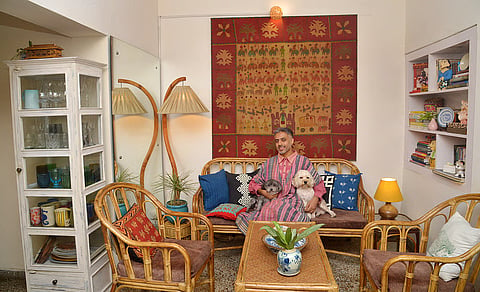
We settled onto a bamboo couch lined with soft cushions as Jugnu and Jigar zigzagged around our feet with their dinosaur plush toys. The living room’s wall was covered by a cloth painting from Udaipur, now framed. Covered in animal and human motifs, it carries a sense of story and movement that drew Malhotra in the first time he saw it. “There’s something going on in there—people, animals, I don’t know the story, but there’s a lot of motion in it. The colours have faded over time, but that’s what makes it even more beautiful.”
Intentional living
Much of his furniture is made of wood, bamboo, or cane — from the bed, couch to the coffee table and the dining table dressed in biscotti-yellow cloth. “I’ve made sure to use cane furniture so everything has an organic feel. It’s durable and sustainable,” he says.
In a world where overconsumption is celebrated, Malhotra wants no part in aesthetic hoarding. For him, sustainability isn’t just about cane and bamboo. His tablecloths are upcycled from old bed linen, and most of his belongings are second-hand, handmade, or bought directly from craftspeople or flea markets. He rarely discards items unless they’re in truly bad shape. “As long as they’re not harming you, I don’t see the harm in keeping them,” he says. What worries him more is how people discard so easily in the name of trends. “That’s just not sustainable.” At home, he keeps things in rotation—gifting away pieces that no longer excite him, often to friends who value their history.
Despite the many antiques and trinkets he’s collected over the years, Malhotra is a deliberate buyer. “To each their own—but for me, a space should feel earned. Every purchase I make is something I’ll remember buying.” It’s part of why he avoids online shopping. “If I think I’ll get bored of it in a few years, I won’t invest.”
Malhotra’s house isn’t minimalist, but not too loud either, for him it’s an emotional space—every corner is intentional and thoughtful. “It has things you value, not just for what they cost, but for the emotions attached to them,” he says. Inherited objects sit alongside newer pieces, creating a thoughtful blend of old and new. “I love that mix. It shows you value craft and textiles passed down through generations, whether as heirlooms or just things that stayed.”
This article is written by Adithi Reena Ajith