
- LIFESTYLE
- FASHION
- FOOD
- ENTERTAINMENT
- EVENTS
- CULTURE
- VIDEOS
- WEB STORIES
- SPORTS
- GADGETS
- CAR & BIKE
- TRAVEL
- SOCIETY
- GALLERIES
- NORTH EAST
- INDULGE CONNECT
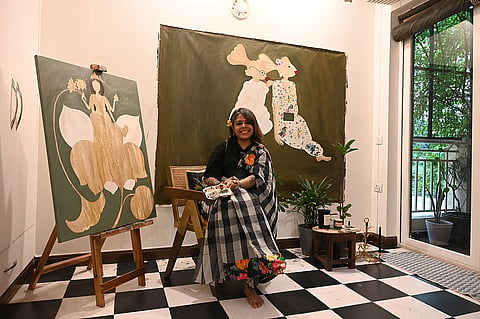
It was a rainy morning in Noida—the kind that turns the skyline grey and the city’s edges soft. But inside artist Neha Sahai’s duplex, everything glowed warm and golden, framed by her plant-laden terraces and an open studio that seems to hold its own sunlight. Stepping in feels almost cinematic, like entering a woodland cottage somehow suspended inside a high-rise.
It’s a self-contained world of sage-green wooden walls, books stacked along the shelves, and tables dotted with trinkets and ceramics—all telling the story of an artist finally at home after years of constant movement, and a long journey toward belonging.
Sahai and her husband, Vaibhav Srivastava, moved to Noida after years of shifting between Mumbai, Gurugram, and Bengaluru. The apartment reflects their two distinct worlds—the top floor is Sahai’s realm, a sunlit living room in sage green, three open terraces, and the studio that doubles as her refuge. Below is Srivastava’s office and a moodier den of dark wood and deep blues. “I love trees, flowers, light—I find clouds magical,” she says. “Vaibhav likes calm, depth, and quiet. Together, it balances us.”
Feeling of home
The daughter of a retired forest officer, Sahai grew up amid the woods—from Nainital to Mirzapur—constantly moving from one town to another. “Since I’ve always lived in the jungle, I’ve never really felt welcomed or had that feeling of belonging,” she says. Switching schools and adapting to new environments left her feeling out of place. Even in college at NIFT, she recalls feeling distant from her peers—almost invisible.
That restlessness now finds its counterpoint in her Noida home—her sanctuary. The upper floor opens into three sunlit terraces overflowing with Champa, Madhumalti, and Bougainvillaea. “I wanted to grow a vegetable garden, but because there’s no direct sunlight, I’m not able to,” she says, pointing at the living room that opens to the terrace, which is one of her favourite spaces in the house besides her studio. “But this light, this space — it’s everything I wanted. Romeo [her dog] loves the terrace and sitting in the sun. Both of us are sun people. We just need our own sunlight.”
Her home is filled with pieces collected over the years—travel souvenirs, thrifted objects, hand-painted ceramics, small sculptures picked up from local markets. From a tiny plate that an Italian ceramic seller on the roadside gifted to her which she cherishes, or the Gustav Klimt painting-turned- ring on her finger or even a vintage Egyptian tile that a friend gifted. Each one, she says, tells a story, unrelated to one another they all find a spot in the house. “You pick up things when you move,” she muses. “And after a while, they become part of your story—the only continuity you have.”
Yet Sahai isn’t a collector for the sake of it. “When we started travelling, we used to buy four or five things from every place,” she says. “Now, we’ve restricted ourselves to one. Buy a thing, give something away. Don’t let it pile up.” There’s an ease to her minimalism, free from the pressure to own or display more.
Letting it be
Sahai’s path to becoming a full-time artist was anything but linear. Trained in fashion at NIFT, she later pursued business and juggled several roles—designer, entrepreneur, brand owner—constantly searching for a balance between stability and self-expression. “I’ve done everything and I’ve never been afraid to start over. Painting, though, was the one thing that stayed,” she says.
A turning point came in 2019 during a trip to Amsterdam, when her Airbnb host offered to buy one of her paintings. “That tiny moment of someone seeing value in what I’d made brought me back to it,” she says. Since then, her art has become both practice and therapy. “Painting slows me down. It doesn’t ask me to adjust. It just lets me be,” she adds.
Her studio is the heart of the house and an extension of her personality: cluttered in the best way, alive with detail. Brushes, colour pencils, and notebooks sprawl across her desk. Fish-shaped trinkets from Portugal sit beside handmade ceramics and sketches and swatches lining the wall, they all carry traces of her journey in every corner.
On the egg-white walls hangs her recent work, Mr. and Mrs. Chatterjee—a reinterpretation of a newlywed couple on their honeymoon. In Sahai’s signature style, her figures have human torsos and fish heads. “This is the first man—a fish man,” she says, gesturing at the canvas. “Fish man, because I have always painted feminine characters.”

Her fascination with hybrid creatures—half-human, half-fish runs through much of her work. “I have this very weird concept that I was a fish in a past life. They are fluid; they can adjust to any current,” she says. “That probably comes from moving around so much as a child. You learn to adapt, to become a little bit everywhere and nowhere at once.”
That ethos of letting it be, extends to the way she hosts people too. “I don’t want guests to feel like they have to sit a certain way or touch things carefully around our house,” says Sahai. “I like when people make themselves at home. That’s what a space should do—it should hold you, not restrict you.”
This article is written by Adithi Reena Ajith