
- LIFESTYLE
- FASHION
- FOOD
- ENTERTAINMENT
- EVENTS
- CULTURE
- VIDEOS
- WEB STORIES
- SPORTS
- GADGETS
- CAR & BIKE
- TRAVEL
- SOCIETY
- GALLERIES
- NORTH EAST
- INDULGE CONNECT
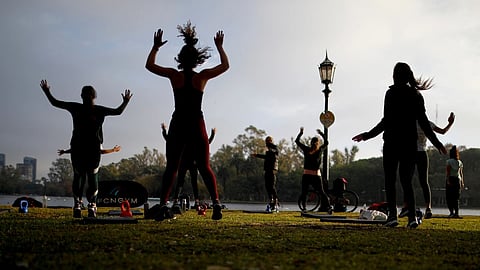
You won’t find dumbbells or fancy machines at Sean Keogh’s gym in Houston. At Calisthenics Club Houston, it’s all about the body — literally. “That’s all we do,” Keogh says. Yet, it’s more than enough to draw in newcomers keen to master pull-ups, handstands, and other gravity-defying moves.
Calisthenics — an age-old form of exercise that uses body weight for resistance — is enjoying a revival. From social media influencers to boutique gyms and fitness chains, everyone seems to be rediscovering the appeal of training with nothing but one’s own body.
Anatolia Vick-Kregel, director of the Lifetime Physical Activity Programme at Rice University, says it’s easy to see why this stripped-down approach is gaining traction. “We don’t always have time to go to the gym,” she explains. “This is something you can do anywhere — at home, in your office, or at the park.”
There’s also a financial incentive. “Calisthenics-based programmes are affordable for individuals and profitable for gyms,” notes Michael Stack, president of the Physical Activity Alliance. With minimal equipment and lower costs, it’s an accessible entry point for those looking to get active — especially after the pandemic normalised home workouts. “This trend has been building for a while,” Stack adds. “The pandemic definitely accelerated it.”

Research suggests calisthenics can improve muscle strength, flexibility, coordination, and even aerobic capacity. “Body weight is phenomenal,” says Vick-Kregel. “It’s one of the simplest yet most effective forms of resistance training.”
Still, calisthenics has its limits. John Raglin, professor of kinesiology at Indiana University, cautions against seeing it as a complete replacement for traditional weight training. “It can be effective,” he says, “but the idea that it can or should replace even simple equipment is misguided.”
He adds that for those with joint issues or reduced strength, certain weight-assisted movements may actually be safer. “If you’re not strong enough or have arthritis, doing a bench press with light dumbbells might be more practical than a push-up,” Raglin explains.
Ultimately, effectiveness depends on what one hopes to achieve. For those seeking bigger muscles or significant strength gains, weights may be necessary. “External load helps you generate more force and build muscle tissue more effectively,” Stack says. As the body adapts, adding more weight becomes essential to avoid plateaus.
But for general fitness and health, body weight alone often suffices. “If your goal is to get moving, build endurance, and feel better, calisthenics is a fantastic place to start,” says Stack. “Your body is the simplest and most accessible tool you have.”
Experts recommend beginning with an honest assessment of your mobility and strength. Check your form for planks, squats, and push-ups — or use modifications like knee push-ups if needed. Once comfortable, aim for two to three sessions a week lasting 10 to 30 minutes.
For structure, Vick-Kregel suggests following The Five Basic Exercises Plan (5BX), a classic calisthenics routine developed by the Royal Canadian Air Force in the 1950s. Gradual progression, she says, is key. “You need to keep challenging yourself — increase the duration, intensity, or complexity of movements as you go.”
And while calisthenics may seem simple, it’s far from easy. “People assume it’s just for beginners,” Keogh says, “but advanced moves like muscle-ups, planches, and front levers can take years to master.”
The renewed interest in calisthenics, then, isn’t just about nostalgia — it’s about rediscovering the strength, control, and creativity of one’s own body. In an age of high-tech fitness, that may be the most empowering workout of all.
For more updates, follow our WhatsApp, Telegram and YouTube channels.