
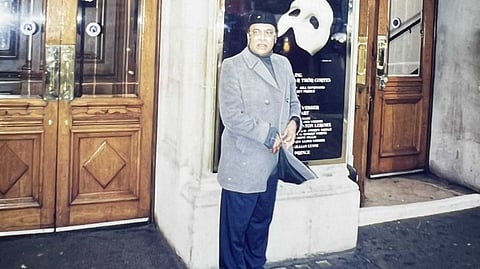
Documentary Bhupen Da Uncut by Bobbeeta Sharma is an unseen portrait of Assam’s musical legend Bhupen Hazarika

As Assam celebrates the centenary of the late legendary singer-songwriter Bhupen Hazarika, the year-long celebrations kicked off with the premiere of a documentary — Bhupen Da Uncut by Bobbeeta Sharma. We catch up with the filmmaker to talk about her documentary-making journey and more.
What inspired you to make the documentary?
This documentary was not planned. In 1999, Bhupen da (Bhupen Hazarika) was invited by Assam Medical College Doctors Alumni Group of England for a cultural programme. Their chief organiser Dr Nripen Barkataki had also invited my husband Chinmoy Sharma and me. This is where we got an opportunity to spend some time with Bhupen da. Chinmoy later did the camera work while filming Bhupen da’s famous song Manuhe Manuhor Baabe (Humans for Human) on the banks of the River Thames and at Tower Bridge.
Moreover, when we were staying together at a flat in London, Chinmoy captured some candid moments with Bhupen da where he spoke at length about his childhood, his interactions with cultural stalwarts like Jyoti Prasad Agarwala, pioneer of Assamese cinema, his pursuit of higher studies in New York, how he met his wife Priyamvada Patel, the dynamics of their relationship, as well as his philosophy and ideology. Most importantly, Bhupen da recited some of his poems, some of which I believe have not yet been published.
Since this year is being celebrated as Bhupen da’s 100th birth anniversary, what better way to pay tribute to him than this documentary? We found the tapes last year and decided to make this documentary and present it to the world.
Did you see the legend in a new light during the process?
Yes. People generally know Bhupen da as a singer, composer, and director. But we got an intimate glimpse into his deeply philosophical mind through his poems. It is evident that whenever his mind was in distress or disturbed, he would write poems — some would be transformed into songs and some remained in the pages of his handwritten notebook, unknown. Apart from this, there was his childlike simplicity and humility. He was a foodie and loved to cook. We have one whole segment of him cooking prawns in Assamese style in Dr Nripen Barkataki’s house in Seaham, England. The way he describes his cooking also gives you subtle social, political, and cultural messages laced with humorous candour.
How did you sort the footage?
We shot this on a Hi-8 camera using tapes. It was filmed in a homely environment. We somehow misplaced the tapes. We thought we had lost them, but fortunately, we found them again last year. With great difficulty, we managed to digitise the tapes. It took us some time to choose the good-quality bits, string them together to make a storyline. We decided to keep most parts as he spoke. That’s why we gave it the title Bhupen Da Uncut. That is the ultimate charm, I think.
I watched the footage for over a month. The lighter moments would continue to bring a smile on my face. The emotions expressed by him continued to touch my heart even after watching it several times. Then we edited them with Ravindra Badgaiyan, for whom I had to translate it into English.
How do you think today’s generation will be able to connect to him?
I feel this documentary has archival value since it is an in-depth first-person account. Our generation got introduced to Bhupen Hazarika’s songs through our parents. Similarly, I feel today’s generation should be introduced to Bhupen da, his life and his songs by us, as parents. Through this documentary, we are only trying to place before everyone whatever Bhupen da felt and expressed, his innermost thoughts, the philosophies he stood for. This is the legacy that we need to pass on to the next generation.
How did his family receive your work?
We were grateful to have his son Tej Hazarika, along with Tej’s wife, Cadence, and their son Sage Akash Hazarika. His youngest brother, renowned singer Samar Hazarika, was also present with his family. Tej and other family members were enthused to see the variations in the documentary and the material that it carries. Tej said that it made Bhupen da come alive once again. Samar Hazarika said that he felt that after going home he would find Bhupen da sitting there waiting for them.
What is your favourite song by him and why?
There are so many. It cannot be just one — Manuhe Manuhor Baabe.
Can we see the documentary travelling to other parts of India and abroad?
The documentary will be screened at Asom Milon - a gathering of Assamese NRI's settled in Europe at their annual meet in Luxembourg in October. It will also be screened by the Assamese community in Warsaw and London to commemorate 100th birth anniversary of Bharat Ratna Dr Bhupen Hazarika.
For more updates, join/follow our WhatsApp, Telegram and YouTube channels.