
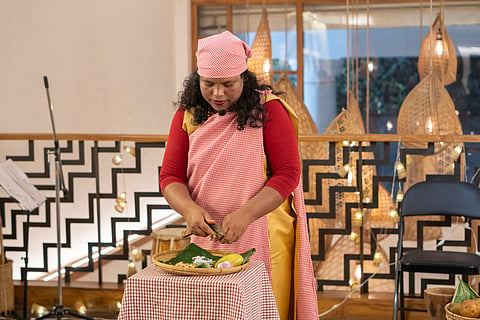
Chef Dial Muktieh on indigenous Bhoi cooking traditions

Chef Dial Muktieh from Meghalaya’s famous Mei Ramew Café gets candid with Indulge about the indigenous dishes and culinary skills of the Bhoi community on the sidelines of her recent pop-up at Delhi’s Taste of the Hills held at Meghalayan Age- The store.
Excerpts:
What got you interested in cooking?
As a child, I used to assist my mother in the kitchen. And when I got married, the responsibility of the kitchen was given to me by my in-laws. So, I was always involved in cooking. After a while, I thought, why not share the dishes with the world, and that’s when I opened the café.
What makes up the traditional Bhoi cuisine, and how is it different from the other prominent cuisines of the belt?
The people from the Bhoi community rely on eating more bamboo, taro leaves, roots, and yams. There is no modern gas usage. Traditionally, food is cooked in a bamboo fire, with very few or no utensils. There is also a heavy focus on the process of fermentation, especially of fish. They are wrapped in leaves, cooked in bamboo fir,e and before consuming seasoned with fresh herbs and vegetables.
What are some of the local ingredients used in Bhoi cuisine?
People rely on fresh and local ingredients, which are also sometimes foraged like Schezwan pepper, perilla seeds, lapong, garlic, and local herbs. Many of the ingredients are so hyperlocal that they are not found in other parts of the country either.
How do you forage for herbs?
Foraging is a skill that we have learnt since childhood, and over the years, the experiences and knowledge gained from them has stayed with me. As children, we used to follow the elders of the community when they went to the forests to pluck herbs. Foraging is also carried out more during spring, autumn, and winter and less during the summer months.
One lesson learnt from your family kitchen
There have been many lessons that I learnt from my mother in the family kitchen. First, we take pride in the traditional method of cooking in a bamboo, which is not common in other parts of the country. Second, sometimes, cooking is done with ash as well. There’s a bamboo river fish dish where the fish is wrapped in a leaf and baked in ash, and slow-cooked in fire. It is then consumed with herb seasoning or slight spices.
How was the experience at the Taste of Hills?
The encouragement that I received from the event will always remain very valuable to me. It was so nice to see people taste and appreciate indigenous cuisine. I presented items like Crab chutney made of river crabs, wild mushrooms, and bamboo rice etc. I even gave them a demonstration to make certain things, or demonstrated the techniques of prepping certain items, the way it is done locally, here.
Two famous dishes from your community/ village
Some of the famous dishes from my community/village, which I recreate even in my café, are smoked fish and dried meat like chicken, which are wrapped in taro leaves and cooked in bamboo. I also make silkworms, which are a delicacy here, and the guests appreciate it a lot.
What is the process of treating silkworms before cooking them?
In the Bhoi community, almost every household grows silkworms as the community is involved in sericulture. Thus, these are locally produced and edible. We soak them in warm water to clean them of the small hair in their bodies or other impurities, and then cook them.
Are their cooking techniques in your community which is slowly disappearing?
Yes, the technique of cooking with bamboo, which in the local language is called psaw, is slowly vanishing from the community. However, I still cook using this technique in my café. When we were young and in the paddy fields, we used to wrap fresh fish in a leaf and stuff it inside ash. Once cooked, we ate them with sprinkled herbs, onions, or chillies.
Are today’s youth interested in traditional culinary skills?
When people come to the café and taste the food, which is very different from what they find in other places, they ask about how it is made and what techniques are involved. So, yes, today people are interested in knowing more about the local culinary skills, which makes the cooking different and the taste very distinct.
Do you think authentic local cuisine should be experimented with or preserved as it is?
Once people deviate from cooking in traditional methods, the taste gets altered and the dish loses its authenticity. Sometimes, it might not even have the same name but become something totally different. For example, traditionally, tapioca is boiled in water and consumed. But today, they are made as tapioca cakes. This has altered the original taste of tapioca.
For more updates, join/follow our WhatsApp, Telegram and YouTube channels.