
- LIFESTYLE
- FASHION
- FOOD
- ENTERTAINMENT
- EVENTS
- CULTURE
- VIDEOS
- WEB STORIES
- SPORTS
- GADGETS
- CAR & BIKE
- TRAVEL
- SOCIETY
- GALLERIES
- NORTH EAST
- INDULGE CONNECT

Oaxaca's food culture begins long before anything reaches the kitchen. In the fields surrounding its villages, maize grows alongside beans and squash, while edible greens emerge among the crops. This agricultural arrangement, known as the milpa, has sustained communities across Mesoamerica for centuries. It also explains why understanding Oaxacan cuisine requires looking beyond its celebrated moles and market stalls to the agricultural knowledge that makes them possible.
The milpa is an integrated farming system rather than a single crop arrangement. Maize provides a structure for climbing beans, while beans contribute nitrogen to the soil. Squash spreads across the ground, helping retain moisture and suppress weeds. Other plants, including chillies and edible greens, may also find a place within the plot. The precise combination varies according to local conditions and community practices.
In Oaxaca, where the landscape changes dramatically between mountain ranges, valleys and coastal plains, this knowledge takes different forms. Indigenous Zapotec, Mixtec, Mixe and Mazatec communities have developed food practices suited to their respective environments. The state's biodiversity is reflected in its markets, where ingredients gathered from the surrounding countryside sit alongside cultivated produce.
Maize remains central to this system. Its importance is particularly evident in nixtamalisation, the process of soaking and cooking dried maize in an alkaline solution, traditionally made with lime, before washing and grinding it. The technique makes certain nutrients more available, improves the dough's properties and produces masa, the foundation for tortillas, tamales and other preparations. It is an agricultural and culinary technology that has shaped Mexican food for generations.
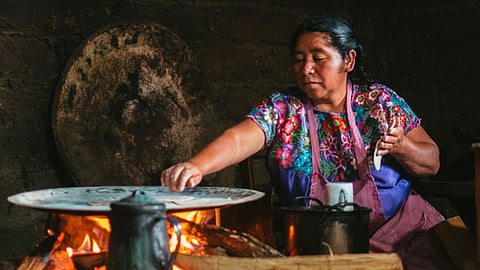
The work does not end with the preparation of masa. Grinding maize on a stone metate, shaping tortillas by hand and cooking them on a comal are skills that remain part of everyday food preparation in many households. The tortilla is often treated as an accompaniment, but its place in Oaxacan meals is more fundamental. It is a staple that can carry a filling, accompany a mole or be used to gather up the last of a sauce.
The region's famous moles offer another way of understanding its food history. Oaxaca is particularly associated with several varieties, including mole negro, mole rojo, mole coloradito and mole amarillo. Their ingredients and preparation differ considerably. Some combine chillies with seeds, nuts, spices and other ingredients, while others rely on particular local chillies and herbs. Their complexity is the result of successive culinary developments, including indigenous techniques and ingredients alongside influences introduced during the colonial period.
However, the everyday food of Oaxaca is equally revealing. Quelites, a broad term for edible greens and herbs, are collected from cultivated fields and uncultivated spaces. Research on traditional markets in Oaxaca has documented numerous species sold under this category, with different plant parts used in different preparations. They may be cooked with beans, added to soups or eaten alongside tortillas. Their continued presence in markets demonstrates how knowledge of local plants remains part of the region's food economy.
Insects also have a place in this food culture. Chapulines, or toasted grasshoppers, are among the best-known examples. Often seasoned with salt, garlic, chilli and lime, they are sold in markets and eaten as snacks or incorporated into other dishes. Their consumption is connected to a much broader understanding of the edible resources available in the region.
Food also follows a ritual calendar. In some communities, preparations are associated with planting and harvesting seasons, religious celebrations and family ceremonies. Among Mazatec communities in the Sierra Mazateca, research has documented the relationship between ritual food, maize cultivation and agricultural offerings. These practices reflect a worldview in which the land and its produce have cultural and spiritual significance.
The women who cook, cultivate and preserve these traditions have an important role in their transmission. Their knowledge includes recognising edible plants, understanding seasonal availability, selecting maize varieties and managing lengthy cooking processes. Traditional cooks have also become increasingly visible in conversations about Mexican culinary heritage, although recognition does not automatically translate into economic security for the communities maintaining these practices.
Tourism and the international popularity of Oaxacan food have brought new opportunities, alongside questions about who benefits from the commercialisation of traditional knowledge. Restaurants may introduce regional ingredients to wider audiences, but the agricultural systems and labour behind them remain vulnerable to changing markets, climate pressures and the growing preference for industrially produced food.
Oaxaca's food heritage is therefore best understood as a living system. Its recipes matter, but so do the fields, seeds, markets and people that sustain them. A tortilla made from locally cultivated maize carries the history of an agricultural practice that is still being worked, season after season.
For more updates, join/follow our WhatsApp, Telegram and YouTube channels