
- LIFESTYLE
- FASHION
- FOOD
- ENTERTAINMENT
- EVENTS
- CULTURE
- VIDEOS
- WEB STORIES
- SPORTS
- GADGETS
- CAR & BIKE
- TRAVEL
- SOCIETY
- GALLERIES
- NORTH EAST
- INDULGE CONNECT

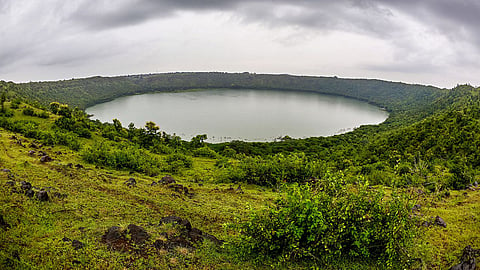
Lonar, sits quietly in Maharashtra’s Buldhana district — another unremarkable stretch of the Deccan plateau and nothing about its approach prepares you for what lies behind the low hills at its edge. Roughly 52,000 years ago, a meteor weighing over a million tonnes struck the Earth’s basalt crust at around 90,000 kilometres per hour. This is a National Geo-heritage Monument.
The crater it left behind is nearly two kilometres wide and 150 metres deep and at its centre sits a hyper-saline, highly alkaline lake of a jade-green so vivid it looks chemically enhanced. It is one of only four confirmed impact craters in the world formed in basaltic rock and the only one with a surviving lake.
Standing at the rim at dawn, the ground drops away sharply. Below, a dense canopy of teak, tamarind and neem insulates the basin from the surrounding plateau and the humidity rises noticeably as you descend the steep, crumbling stone path to the shoreline — a drop of roughly 130 metres accompanied by langur monkeys overhead and the distant, unsettling call of peacocks.
The water at the bottom has a pH sitting around 10.5 and a low sulphurous note hangs in the air. The dark mud underfoot contains maskelynite glass, a mineral formed only under the shockwaves of a meteor impact, found elsewhere only on the moon.
What separates Lonar from every other impact site on Earth is what was built here afterwards. The Chalukya dynasty raised a series of temples along the crater rim and within the jungle fringe during the 12th century, in the Hemadpanti architectural style. The Daitya Sudan Temple in the town itself — carved entirely from black stone, its surface dense with deities and mythological figures — is worth a visit before you begin the descent. The entry free to the lake is ₹40.
For more updates, join/follow our WhatsApp, Telegram and YouTube channels.