
- LIFESTYLE
- FASHION
- FOOD
- ENTERTAINMENT
- EVENTS
- CULTURE
- VIDEOS
- WEB STORIES
- SPORTS
- GADGETS
- CAR & BIKE
- TRAVEL
- SOCIETY
- GALLERIES
- NORTH EAST
- INDULGE CONNECT

The world celebrates Satyajit Ray the filmmaker. The doyen of cinema who took Bengali cinema to the global stage and made the world turn their heads and take Indian Cinema seriously. However, a film needs more than what we see on screen to bring the story alive. The soundscape is equally, if not more, important to rightfully convey the meaning and emotion a director wants to capture.
While music in films is largely studied all around the world, it is especially important to understand the magic that Ray creates with music in his films. The director used music as the beating heart in his works. Music gave his films life. Today, when you scroll through social media, you'll find his music playing in the background of reels that have nothing to do with cinema. Although it speaks of a dangerous trend that makes us chase what is popular and nostalgic without delving deep into the subject matter, as we celebrate Satyajit Ray's 105th Birth Anniversary, we must not let his work lose relevance and get diluted to represent waning glory of the yesteryears.
Music has always been an integral part in the legendary filmmaker Satyajit Ray's filmography. Music was not mere beautification, but a medium to express meaning.
The director redefined what music in films can be. To him, everyday cacophony, the chaotic soundscape of the city, the sound of a woodpecker, the familiar sound of the tram bells, were all music that highlighted the message in his films.
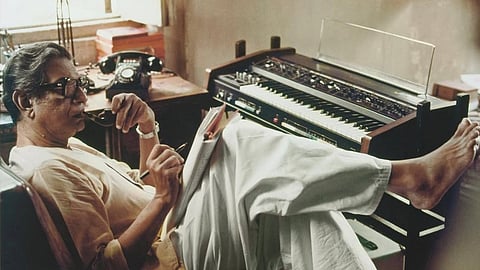
To understand Ray's use of music in his films, we must understand the musical genius he himself was. He was many talents all wrapped in one: writer, filmmaker, music composer, lyricist, sound designer and more. He had the heart and soul of a true musician who knew exactly what he wanted for his films.While he worked with renowned musical virtuosos on his early films, he soon realised, he was the only musical mind he needed.
Ray's seventh film, Teen Kanya (1961) marked the first time the filmmaker took on the role of a score composer. He went on to work on the background score of all his films hereon. This shift was carefully thought out. The director has expressed multiple times that he felt uncomfortable dictating musical greats on what to do and hence, decided to do the work himself.
Satyajit Ray collaborated with doyens of Indian Classical Music for his early films. Sitar virtuoso Pandit Ravi Shankar famously did the music for the Apu Trilogy and Parash Pathar, sitar great Ustad Vilayat Khan did so for Jalsaghar and sarod legend Ustad Ali Akbar Khan worked on Devi. Soon after, he decided not to work with professional composers anymore.
In his book on filmmaking, Bishoy Chalachchitra (Speaking of Films), Ray said that since classical musicians were not professional film composers, he found it difficult to record short pieces since the maestros were used to playing for extended periods.
In an interview with a young Shyam Benegal, he had said, "Well, in the beginning...I was not my own composer...But I always knew where the music would come...I had to tell the composers beforehand that these are the points where I needed music. And this of course led to some difficulties because I was getting musical ideas of my own at that time and and composers, understandably enough, resent being guided too much."
He added, "And later, of course, I took over composing myself because for one thing, most of the time they were not available. And for another, I felt that since I couldn't think of another composer to use, I didn't think there were very many useful, good professional film composers."
Ray's music is marked by a striking fusion of Western and Eastern music and they have been very carefully brought together or kept apart in his films. The music never overpowers the storytelling, it only complements it.
The director experimented with music which notably began with Devi, his sixth film. While the background music was composed by Ustad Ali Akbar Khan, a little known fact is that he composed a Shyamasangeet, Ebaar Tore Chinechhi Ma, for the film, based on the famous Ramprasadi style. This shows the director's familiarity with Bengali folk forms.
His deep knowledge of folk music further shone through the widely popular song, Kotoi Rongo Dyekhi Duniyay from Hirak Rajar Deshe which is a Baul composition. From bhajans in Braj Bhasha to Rabindrasangeet and more, his films featured diverse musical genres.
Despite his incredible knowledge of both Indian and Western musical cultures, Ray did not use music without discretion or reason. Speaking to Shyam Benegal, he said that the use of western or Indian soundscape completely depended on the film and the story. "For a film like Pather Panchali or perhaps any one of the trilogy films, it would have to be Indian to a large extent."
He added, "But I have also tried fusion, fusing, Indian, Western idioms. This I do constantly in films which deal with contemporary Calcutta, for instance, which is in itself a kind of a fusion."
The auteur worked on the music of his films from the very early stages. Well versed in both Indian and western notations, he would write the scores depending on the musicians. He wrote, "The pleasure of finding out that the music sounds as you had imagined it would, more that compensates for the hard work that goes into it. The final pleasure, of course, is in finding out that it not only sounds right but is also right for the scene for which it was meant”.
Ray used music extensively in his works. It was, however, an "extraneous element" for him. Had he been the audience, he wouldn't have used music, he had said.
During a discussion with Samik Bandyopadhyay, he said, "Music is something which I always feel is, up to a point, a dispensable element. One uses music more with the public in mind than anything else, because one is afraid that the public will not be able to get the mood of a certain scene. And you want to underline it, so don't miss it, which is unfortunate, but you have to do it. I'm trying to be economical with music."
He discussed his gradual shift to using random sounds as music in his films. "Now more and more I use less and less music, I find because I can use.The mixing facilities have improved and I can use a more creative soundtrack whereby one can use actual sounds almost as you use music to suggest moods and things like that", Ray added.
Satyajit Ray changed the soundscape of Bengali cinema and established music as a separate character. Beyond his classic films, he penned several songs that went on to have lives of their own, continuing to be relevant for the inherent social message in the lyrics. For more updates, join/follow our WhatsApp, Telegram and YouTube channels.